When ROAS Falls, Most Brands Fix the Wrong Thing
Your ROASROASReturn on Ad Spend, the ratio of revenue generated to money spent on advertising, typically expressed as a multiplier such as 3x meaning three dollars returned per dollar spent. dropped. You know what happens next: someone pulls the creative report, someone else suggests pausing the worst ad sets, and by Thursday you’re briefing the agency on a new concept. Six weeks later, the new creative is live, ROAS is still soft, and you’ve burned the quarter running from a symptom.
This is the most expensive mistake in performance marketing. Not the drop itself - the reflex that follows it.
The Three Actual Causes (In Order of Likelihood)
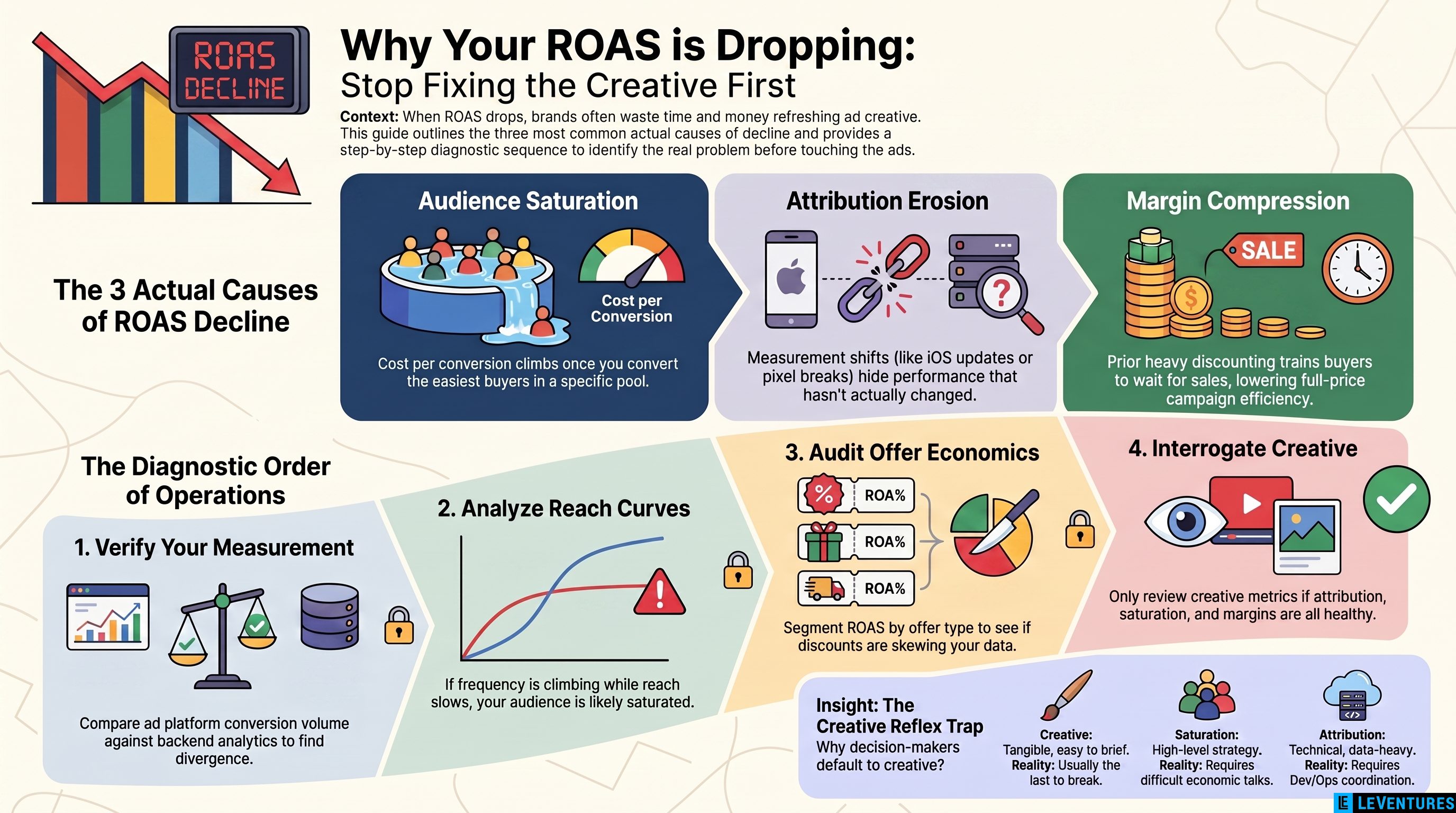
ROAS declines almost always trace back to one of three things, and creative is rarely any of them.
Audience saturation. Your best-performing audiences - the lookalikeslookalikesAudiences created by ad platforms by finding new users whose behaviors and demographics closely resemble an existing group such as past buyers. built off buyers, the retargeting pools from high-intent pages - have a ceiling. Once you’ve converted the easiest buyers in a given pool, the cost per conversion climbs because you’re reaching people who were less likely to convert in the first place. This looks like a creative problem. It isn’t. New ads served to a saturated audience will disappoint too.
Attribution erosion. Something changed in how you’re counting conversions. It might be iOS privacy updates compressing your view-through windowsview-through windowsThe defined time period after a user sees an ad without clicking it during which a later purchase is still counted as a conversion credited to that ad., a pixel that broke after a site deploy, GA4 session attribution behaving differently than Universal Analytics did, or an ad platform that quietly shifted from last-clicklast-clickAn attribution model that gives full credit for a conversion to the final ad a user interacted with before completing a purchase. to data-driven without your noticing. Your actual performance may not have changed at all. What changed is the measurement.
Margin compression from prior discounting. This one is particularly sneaky. If you ran a promotion six weeks ago and trained buyers to expect a discount, your conversion rate may actually be holding - but only at discounted AOVAOVAverage Order Value, the average dollar amount customers spend per transaction.. Revenue looks similar, margins look fine at the surface level, but ROAS on full-price campaigns has softened because you’ve shifted your buying population toward discount-seekers. The ads didn’t get worse. The customer economics did.
Run the Diagnosis Before You Touch Anything
The right order of operations when ROAS drops:
-
Check attribution first. Pull conversion volume from your ad platform and compare it to what your backend or analytics stack actually recorded for the same period. If those numbers diverge meaningfully, you have a measurement problem, not a performance problem. Fix that before drawing any conclusions.
-
Look at frequency and reach curves. If your frequency on core audiences has climbed over the past 30-60 days and new reach has slowed, saturation is the likely culprit. The fix is audience expansion or exclusion adjustments - not creative.
-
Segment ROAS by offer type and AOV. If discounted orders account for a growing share of recent conversions, you’re seeing margin compression reflected as ROAS decline. The fix is pricing and offer strategy - not creative.
-
Only then open the creative report. If attribution is clean, audiences aren’t saturated, and margin mix is healthy, you now have permission to interrogate creative. Hook rates, scroll-stop, thumb-stop ratiosthumb-stop ratiosThe share of users who pause scrolling to watch a video ad, used as a signal that the opening moments successfully captured attention. - at this point, that analysis is actually useful.
Why Everyone Skips to Creative
Creative is tangible. You can see it, brief against it, and ship a new version. It creates the feeling of action, which is what everyone wants when numbers are down.
Audience saturation requires a harder conversation about growth ceilings and acquisition economics. Attribution problems require coordination between platform, analytics, and dev teams. Margin compression requires someone to have an uncomfortable discussion about discount strategy with whoever owns pricing.
Creative is just easier to touch. That’s the whole explanation.
The irony is that creative fatiguecreative fatigueThe decline in ad performance that occurs when an audience has seen the same ad so many times they stop responding to it. - the one thing everyone jumps to fix - is usually the last thing to actually break. Well-performing creative on a healthy audience with clean attribution has a longer useful life than most brands assume. They refresh it prematurely and conclude the new version “isn’t working” without realizing they moved the variable that mattered least.
Fix the measurement. Fix the audience. Fix the economics. Then worry about the ads.