ChatGPT Is About to Run Ads - Here's What Ecommerce Brands Should Do Before April
Most ecommerce brands are sleeping on this.
ChatGPT just crossed $100M in ad revenue. Self-serve ad access opens in April. And somewhere between “agentic commerce” and native checkout integrations, the way people buy things online is about to shift in a way that makes the early TikTok ads era look small.
If you run a Shopify store and you’re still thinking of ChatGPT as a chatbot - a place people ask questions, not a place they buy things - you’re already behind.
Here’s what’s actually happening, and what to do about it before April.
What “ChatGPT Ads” Actually Means
This isn’t banner ads slapped onto a chat interface. That’s not how OpenAI is building this.
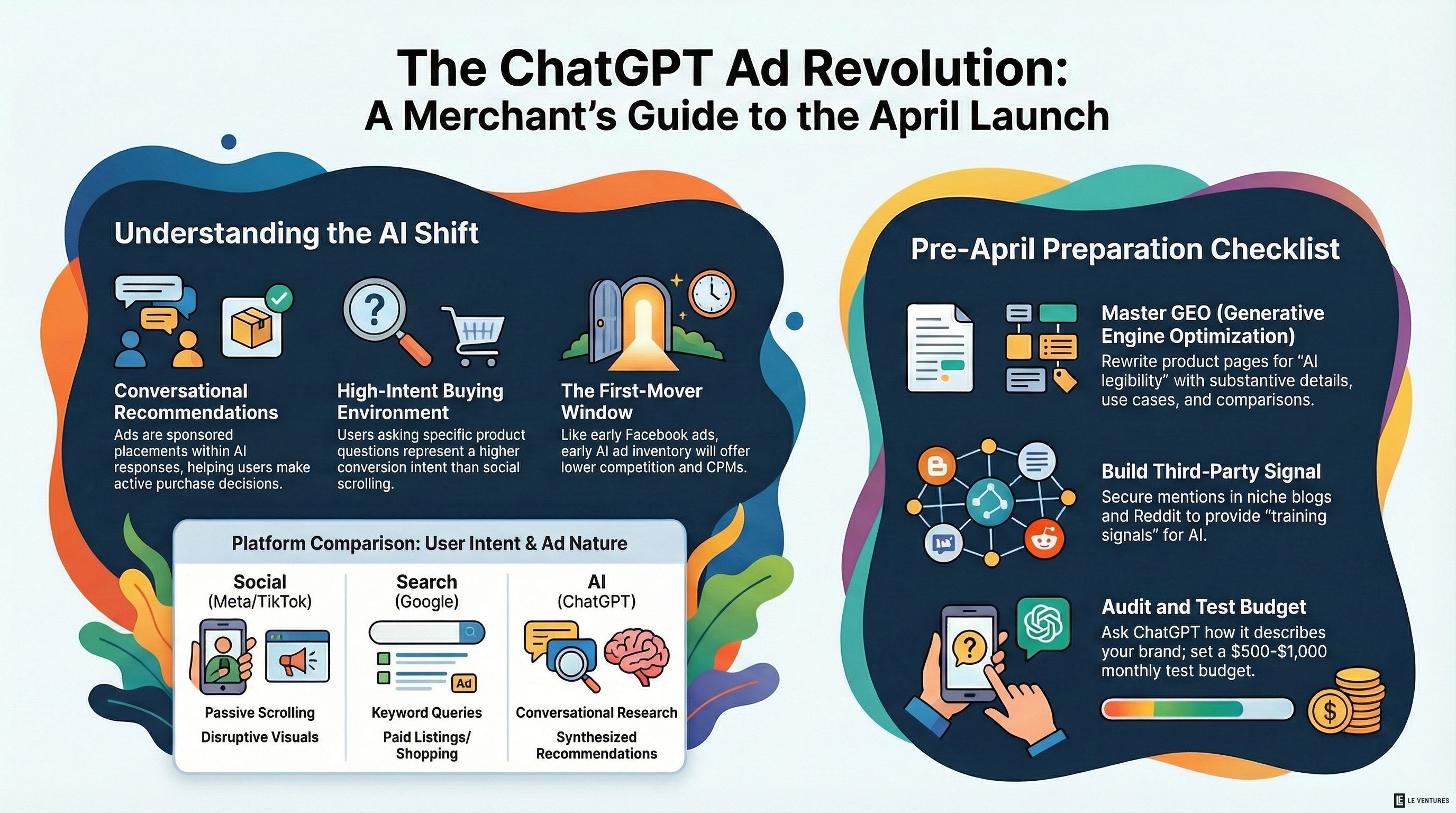
The current model looks closer to sponsored placements within responses - where ChatGPT is already recommending products, tools, or services, and brands can pay to be surfaced in those recommendations. Think less Google Display, more Google Shopping, but inside a conversational layer that’s actively helping someone make a purchase decision.
The reason this matters: ChatGPT isn’t just showing people options. It’s synthesizing context, comparing products, and often making a specific recommendation. When someone asks “what’s the best lightweight running shoe for someone with flat feet under $150,” they’re not browsing. They’re buying. The intent level is extremely high.
That’s a very different environment than a passive scroll on Meta or a search result page. And the brands that figure out how to show up there early will get outsized returns - the same way early Facebook advertisers got $0.01 clicks before the channel got competitive.
The First-Mover Window Is Real (And Short)
Go back to early Facebook ads: 2009, 2010. CPMs were cents. Targeting was novel. Brands that got in early built audiences, learned the platform, and compounded those advantages for years.
Same story with TikTok ads in 2019-2020. Brands that jumped in when the Creative Center didn’t even exist yet were running profitable campaigns at a fraction of the cost they’d pay today.
New ad platforms reward early entrants with cheap inventory, less competition, and - critically - the time to learn what actually works before everyone else figures it out.
ChatGPT’s self-serve access in April is that moment. It won’t stay cheap or uncrowded for long. Big brands with large agency budgets will flood it by Q3. The window for smaller Shopify merchants to move fast and learn cheap is right now.
What This Means for Your GEO Strategy (And Why They’re Connected)
GEO - Generative Engine Optimization - is the practice of optimizing your brand and content to be cited, recommended, or surfaced by AI models like ChatGPT, Perplexity, and Google’s AI Overviews.
Here’s the thing most people miss: paid and organic in AI search are not separate strategies. They’re deeply connected.
When ChatGPT recommends a product, it’s drawing on what it knows about that brand - from training data, from web content, from product descriptions, from reviews. If your brand has thin content, poor product copy, or zero presence in the places AI models scrape, a paid placement isn’t going to do much. The model doesn’t know enough about you to make a convincing recommendation.
Before you spend a dollar on ChatGPT ads, you need to make sure your brand is legible to AI. That means:
Your product pages need to be substantive. Not keyword-stuffed - actually informative. Materials, dimensions, use cases, comparisons. The kind of detail a knowledgeable salesperson would give. AI models love specificity.
You need third-party mentions. Press coverage, reviews, Reddit threads, niche blogs. AI models treat third-party sources as credibility signals the same way Google does, but with heavier weighting toward natural language context.
Your brand voice needs consistency. If your site says one thing, your reviews say another, and your social says something else, AI models get confused and hedge. Consistent, clear positioning across touchpoints helps AI recommend you with confidence.
Get these in order now. By the time you’re running paid placements in ChatGPT, you want the organic layer working underneath it.
Concrete Actions to Take Before April
Stop reading about this and start doing it. Here’s the actual list:
1. Audit how ChatGPT currently talks about your brand. Go to ChatGPT and ask about your category. Ask for product recommendations. Ask follow-up questions. See if your brand comes up. If it doesn’t, figure out why - usually it’s content gaps or authority gaps.
2. Fix your product content this month. Rewrite your top 5 product pages with an AI-legibility lens. Include use cases, comparisons to alternatives, specific details, and answers to the questions buyers actually ask. This helps both GEO and conversion rate, so it’s never wasted work.
3. Build a review and mention strategy. Reach out to niche publications, bloggers, and content creators in your category. Get covered. Get linked. Not for backlinks in the old SEO sense - for AI training signal. The content that AI models know about is the content that gets recommended.
4. Set aside a test budget for April. You don’t need a huge number. $500-1000/month to start is enough to learn the platform before you scale. The goal in month one is data, not ROAS. Understand the formats, the audience, the intent signals. Then scale what works.
5. Watch for agentic commerce integrations. This is the medium-term play. OpenAI is building toward AI agents that don’t just recommend products - they buy them. Checkout integrations, auto-reorder, AI-managed wishlists. Shopify merchants who have clean product data, good API infrastructure, and optimized checkout flows will be ready when this lands. The ones who don’t will be scrambling.
Who the Early Movers Will Be
Based on what we’re seeing, the Shopify brands that move first on ChatGPT ads will be in categories where buyer research is high - supplements, skincare, tech accessories, home goods, apparel with specific fit or material questions. Categories where buyers ask a lot of questions before purchasing are perfectly matched to an AI-native ad environment.
Brands with strong content operations - who already invest in product education, comparisons, and detailed descriptions - will have a head start. The groundwork they laid for SEO is directly transferable to GEO.
The brands that will struggle are those relying on visual-heavy, low-information product pages built for Instagram impulse buying. That approach does not translate to conversational AI search. Those brands need to start building content infrastructure now.
The Bottom Line
April is a concrete deadline. Self-serve ChatGPT ads will open up, and within months, every major brand and agency will be running experiments. The first-mover advantage will start eroding fast.
The brands that win won’t just be the ones who bought ads first. They’ll be the ones who spent February and March making sure their brand was optimized for the channel before they put money into it.
GEO foundation. Content infrastructure. Product copy that an AI model can actually use. Then paid amplification on top.
That’s the stack that works.
If you’re not sure where your brand stands - how AI models currently see you, where your content gaps are, or whether you’re set up to capitalize on what’s coming - we do a free audit at Le Ventures. We’ll show you exactly what ChatGPT says about your brand today and where the biggest opportunities are before April. Reach out and we’ll get it done.