The AI Attribution Blind Spot That's Making Your Best Marketing Channel Invisible
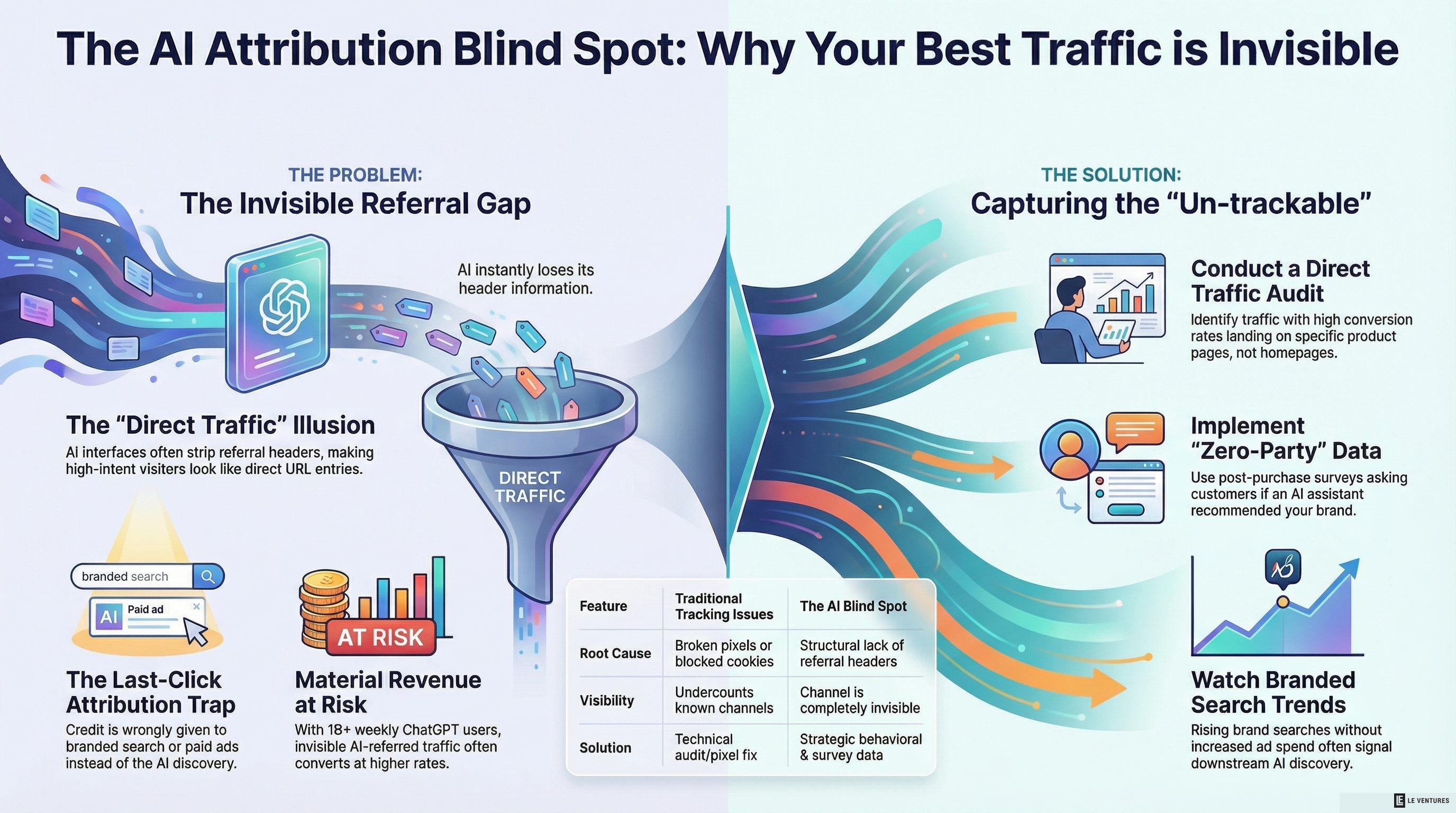
You’re probably already getting traffic from ChatGPT, Perplexity, and Gemini. You just can’t see it.
That’s not a tracking pixel problem. It’s not a UTM tagging error. It’s a structural gap in how attribution tools were built - and it’s getting more expensive to ignore every single week.
What’s Actually Happening
When someone asks ChatGPT “what’s the best project management tool for a 10-person agency,” gets a recommendation, clicks through to your site, and buys - where does that show up in your analytics?
Usually as direct traffic. Sometimes as a referral with a partial or unreadable source. Occasionally it just vanishes.
AI-assisted discovery doesn’t follow the same referral mechanics as Google or a paid ad. Traditional browsers pass a referrer header when someone clicks a link. Many AI interfaces don’t. ChatGPT’s web browsing, Perplexity’s answer engine, Google’s AI Overviews - these sessions often arrive at your site with no referral information, or with a referral string that your analytics platform doesn’t know how to classify.
The result: a customer who discovered you through an AI recommendation looks identical to someone who typed your URL directly. Last-click attribution gives the credit to whatever touchpoint comes after - often a branded search or a direct visit - and the AI channel stays invisible.
Why This Is Different From Your Other Tracking Problems
If you’ve dealt with broken pixels, blocked cookies, or GA4 migration headaches, you might think this is more of the same. It’s not.
Those are measurement failures on channels you already know about. A broken Facebook pixel means you’re undercounting a channel you can see. This is about a channel that doesn’t show up at all.
There’s no campaign structure to audit. No pixel to fix. No dashboard you can pull up that shows “AI referral” as a line item - because the attribution infrastructure for this channel simply doesn’t exist yet in most tools.
That distinction matters because the fix is different. You can’t solve an invisible channel problem the same way you solve a broken tag problem.
How Big Is the Gap Right Now
Honestly? Nobody knows precisely - and that’s the point.
What we do know: ChatGPT crossed 1 billion weekly active users. Perplexity is processing hundreds of millions of queries per month. Google’s AI Overviews are showing on a massive percentage of search results. Shopping queries specifically are one of the fastest-growing use cases across all of these platforms.
If even a small percentage of those interactions result in site visits, and those visits convert at a higher rate than cold traffic (which they often do, because the user already received a recommendation before they arrived), then the gap in your attribution data is material.
The businesses most affected are the ones with strong brand signals - you’re already being recommended, you just can’t prove it or optimize for it.
What You Can Actually Do About It
You’re not going to solve this perfectly. But you can get significantly better signal than you have right now, and that’s worth the effort.
Start with a direct traffic audit. Pull your direct traffic segment and look at behavior metrics - pages per session, conversion rate, time on site. If your direct traffic converts significantly better than your other acquisition channels, that’s a signal that it contains high-intent AI referral traffic mixed in. Segment by landing page too. AI-referred visitors often land on specific product or category pages, not your homepage.
Set up referral monitoring for AI domains. Tools like GA4, Fathom, and Plausible will occasionally capture AI referrals when the browser does pass a referrer. Create a segment or filter for known AI domains: chat.openai.com, perplexity.ai, gemini.google.com, copilot.microsoft.com. It won’t capture everything, but it captures something.
Add UTM parameters to any content you control on AI platforms. If you’re posting in ChatGPT plugins, using Claude Projects for customer-facing tools, or syndicating content that gets indexed by AI platforms, tag those links. You control those touchpoints.
Survey your customers. Seriously. Add a “how did you first hear about us” question to your onboarding or post-purchase flow. Give AI assistants as an explicit option. The self-reported data is imperfect but it will show you the gap between what customers tell you and what your analytics shows.
Watch your branded search volume. One reliable downstream signal of AI-driven discovery is an increase in branded search. People get recommended you, then Google your name to find your site. If branded search is growing without a corresponding increase in attributable top-of-funnel spend, AI referrals are a likely contributor.
The Strategic Problem This Creates
Here’s where it gets expensive.
If you’re making budget decisions based on last-click or even multi-touch attribution right now, you’re optimizing a model that’s missing a growing slice of your actual funnel. You might be underinvesting in content, thought leadership, or brand presence - the things that get you recommended by AI systems - because you can’t draw a direct line from those investments to revenue in your current tools.
Meanwhile, you’re probably overweighting bottom-of-funnel paid channels because those clicks are trackable and the attribution looks clean. The attribution looks clean because the AI referral that actually started the journey is invisible.
This is how you end up cutting the thing that’s working.
What to Do With Your Attribution Model Right Now
Don’t wait for your analytics vendor to build a solution. Most of them are 12-24 months behind on this.
Instead, build a supplementary measurement layer. Combine your analytics data with customer surveys, branded search trends, and direct traffic behavior to construct a more complete picture. It’s less precise than a clean attribution model, but it’s more accurate than confidently optimizing a model with a known blind spot.
Treat AI discoverability as a channel with its own investment logic. What makes you recommendable to an AI system? Authoritative content, strong review presence, clear product descriptions, structured data markup. These are investments with a different ROI timeline than a paid click, but they’re compounding in a channel that’s growing faster than anything else right now.
And start tracking the directional signals now, even if they’re imperfect - so that when better tooling emerges, you have a baseline to measure against.
If you’re not sure where your attribution gaps are or how much revenue might be misattributed right now, Le Ventures offers a free marketing data audit. We’ll look at what your current stack is actually measuring, where the gaps are, and what it would take to get a more complete picture. Reach out to get started.