What Is MCP and Why It's the Biggest Shift in Business AI Since ChatGPT
Most businesses are still using AI like a fancy search engine. You type a question, you get an answer, you copy it somewhere useful. That’s fine - but it’s not what AI is becoming.
There’s a new infrastructure layer spreading quietly across the enterprise AI world. It’s called MCP - Model Context Protocol - and it’s the reason AI is about to stop being a tool you talk to and start being a worker you deploy.
If you run a business and you haven’t heard of MCP yet, read this carefully. The gap between companies that understand it and companies that don’t is going to be enormous by the end of 2026.
What MCP Actually Is (No Jargon)
Model Context Protocol is an open standard, originally developed by Anthropic, that gives AI models a standardized way to connect to external tools and data sources.
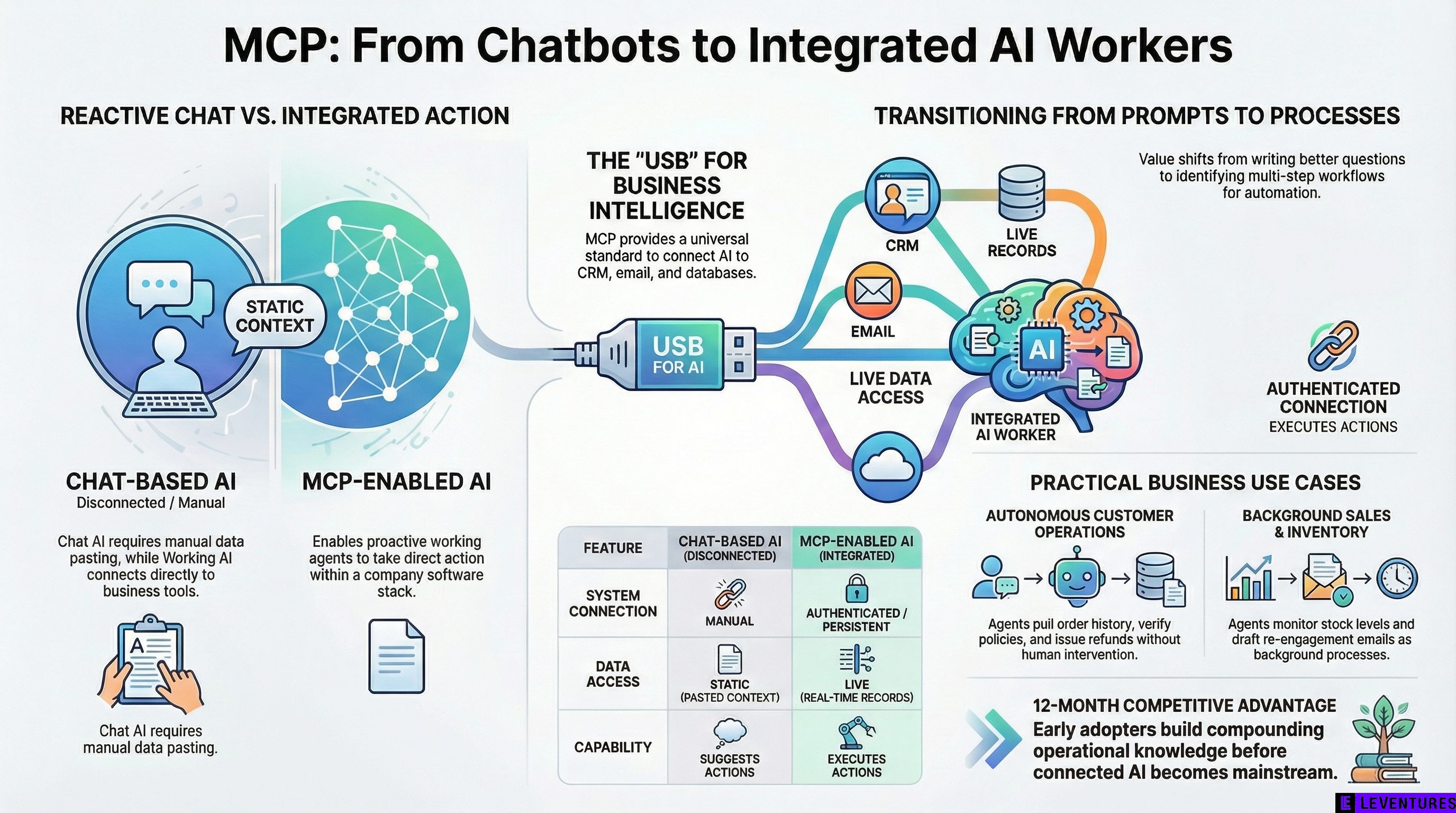
Think of it like USB. Before USB, every peripheral had its own proprietary connector. Keyboards, printers, cameras - everything needed a different port, different driver, different setup. USB created one universal standard and suddenly everything just worked together.
MCP does the same thing for AI. Instead of building a custom integration every time you want your AI to touch your CRM, your inventory system, your email platform, or your ops tools - MCP provides the standard protocol that lets an AI agent connect to all of them in a consistent, reliable way.
The result: AI that doesn’t just answer questions about your business. AI that can actually operate inside it.
The Difference Between Chat AI and Working AI
Here’s the distinction that matters.
Chat AI is reactive. You ask it something, it responds, you move on. It has no persistent connection to your systems. It can’t pull your actual customer records, update a ticket, send an email on your behalf, or check your live inventory. It’s working from whatever context you paste into the conversation window.
Working AI - the kind MCP enables - is integrated. It has authenticated, structured access to your real tools. It can read your CRM contacts, log a note after a call, trigger a workflow, update a spreadsheet, draft and send a follow-up, and flag an anomaly in your ops data. Not as a one-off hack, but reliably, at scale, on a schedule or triggered by an event.
That’s a fundamentally different category of capability. And MCP is the infrastructure layer making it possible without requiring every business to build custom integrations from scratch.
Why This Matters Right Now
MCP adoption is accelerating fast. Major tools - including integrations with Slack, Google Workspace, Salesforce, Shopify, and dozens of others - are already building MCP-compatible connections. The agentic commerce wave you’re seeing in ecommerce tool roundups? MCP is the architecture underneath it.
What this means practically: the AI agents being built today on MCP-connected infrastructure are dramatically more capable than the chatbot workflows businesses were building 18 months ago. They don’t just suggest actions - they take them.
For business operators, the implication is simple. The question is no longer “can AI help us move faster?” It’s “are our systems connected in a way that lets AI actually work inside them?”
What This Looks Like in Practice
Here are concrete examples of what MCP-enabled AI agents can do that chat AI cannot:
Customer operations: An AI agent connected to your helpdesk, CRM, and order management system can handle a refund request end-to-end - pulling the order history, verifying the policy, issuing the refund, updating the CRM record, and sending the confirmation - without a human touching it.
Sales workflows: An agent with access to your email, calendar, and CRM can identify leads that have gone cold, draft personalized re-engagement emails based on past interactions, schedule follow-ups, and log everything - running as a background process while your team focuses on closing.
Inventory and ops: An agent connected to your inventory system and supplier communication tools can monitor stock levels, flag reorder thresholds, draft purchase orders, and send them for approval - all triggered automatically when conditions are met.
Reporting and analysis: Instead of manually pulling data from five systems into a spreadsheet, an agent can query your tools directly, compile the report, identify anomalies, and surface the three things that actually need your attention.
None of this requires building a massive custom software platform. MCP is designed so that if your tools support it, the connections are relatively fast to establish and maintain.
What You Should Actually Do With This Information
First, audit your current AI usage. If your team is primarily using AI through a chat interface and manually moving outputs into other systems, you’re leaving serious efficiency on the table. That manual transfer is exactly the gap MCP closes.
Second, ask your software vendors whether they support MCP or have it on their roadmap. Shopify, HubSpot, Notion, Linear, and many others are moving in this direction. If your critical tools are MCP-compatible, you’re in a position to build connected workflows now.
Third, think in terms of processes, not prompts. The value of MCP-enabled AI isn’t in getting better answers to one-off questions. It’s in identifying the repetitive, multi-step processes in your business - the ones that touch multiple systems - and turning them into automated agent workflows. Where does a human currently act as the bridge between two systems? That’s your MCP opportunity.
Fourth, don’t wait for a perfect setup. Businesses that start experimenting with connected AI workflows now will have 12 months of operational learning by the time this is mainstream. That lead compounds. The teams that understand what their agents can and can’t do reliably - and have built the oversight processes around them - will outperform teams starting from zero.
The Real Unlock
The reason MCP is a genuine inflection point isn’t the technology itself. It’s what it removes: the friction between AI capability and business reality.
For the past three years, the gap between what AI could theoretically do and what it could actually do inside a real business was enormous. Systems weren’t connected. Integrations were brittle. Getting AI to reliably act inside your tools required serious engineering investment most businesses couldn’t justify.
MCP is collapsing that gap. It’s making the infrastructure layer accessible enough that business operators - not just engineering teams - can start building workflows that actually stick.
The businesses that understand this now, and start mapping their processes to connected AI workflows, are going to look like they have an unfair advantage in 18 months. They will.
If you’re not sure whether your current systems and workflows are positioned to take advantage of this, Le Ventures offers a free AI audit for business operators. We’ll look at your stack, identify the highest-leverage opportunities for connected AI, and give you a clear picture of where to start - no sales pitch, just a straight read on where you are and what’s actually worth building.