You Are Just a Human Translation Layer!
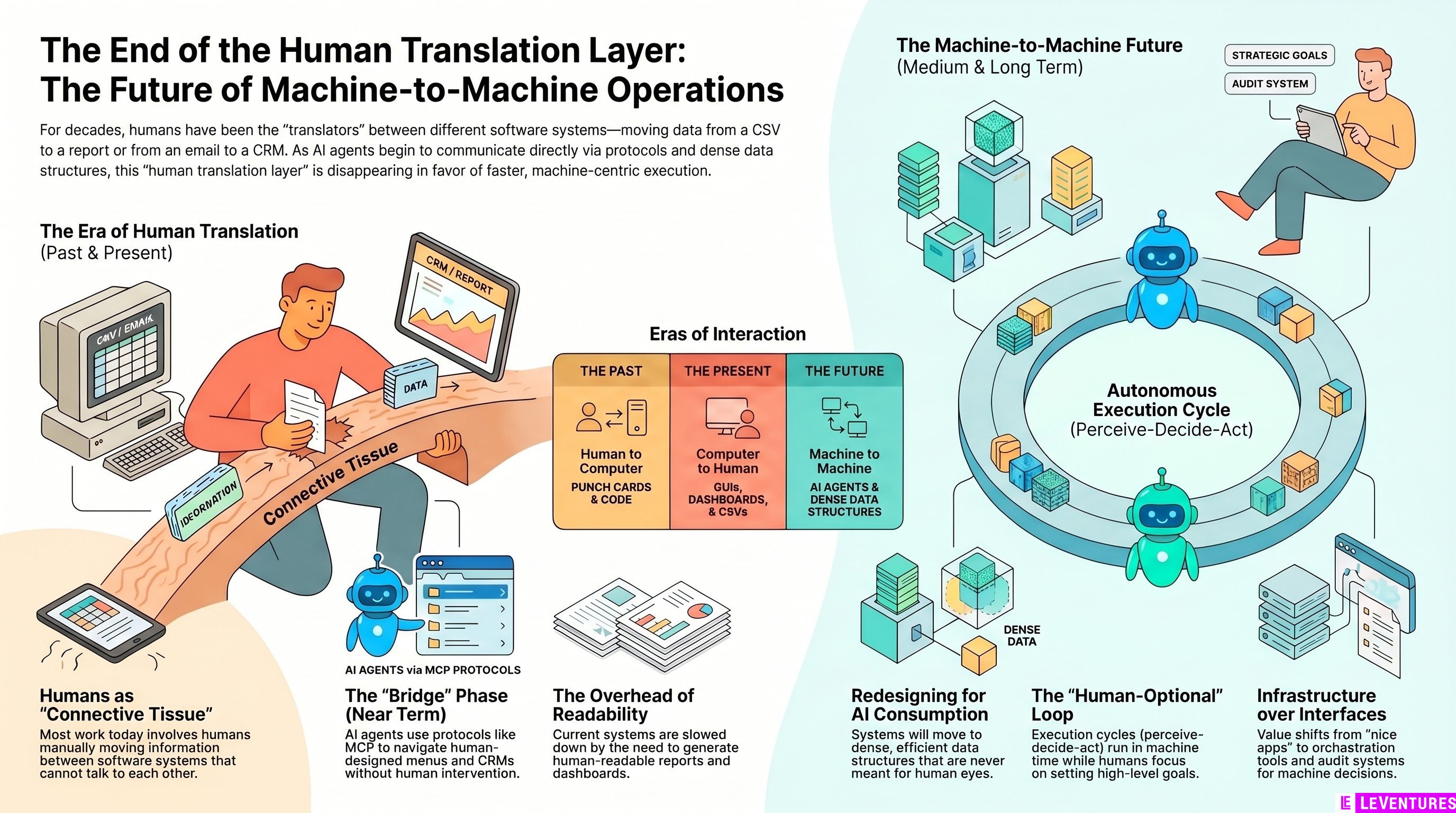
We Spent 70 Years Making Computers Talk to Humans. That Era Is Ending.
Think about where we started.
Punch cards. Literal paper with holes in it. You typed your instructions, fed the cards into a machine, and waited. The computer didn’t care what you thought was readable. You spoke its language, or you didn’t get output at all.
Then we got good at making computers meet us halfway. GUIs, spreadsheets, dashboards, PDFs, HTML. Decades of engineering effort pointed at one goal: take raw data and turn it into something a human can look at and understand. We built entire industries around this. Data visualization companies. BI tools. Report generators. Document formats.
The result was that work got busy in a very specific way. Information moved from computer to human, then from human back to computer, over and over. A system exports a CSV. A person opens it, reads it, types something into another system. That other system generates a report. A person reads the report, emails a summary. Someone reads the email, updates a spreadsheet.
Humans became the connective tissue between software systems. We were the translators.
That translation job is about to disappear.
The Translation Layer Is Getting Automated
The first signs are already here, and most businesses are underestimating what they’re looking at.
MCP, the Model Context Protocol, is a good example of the near-term phase. It’s a standardized way for AI agents to connect to tools, read context, and take actions. The practical effect is that an AI can now interact with your CRM, your calendar, your database, without a human sitting in the middle telling it what each field means.
This is still human-format-to-computer. The systems were built for humans. The AI is just learning to navigate them. It’s reading the menus we designed for people.
But it’s a critical bridge. It lets AI start doing real work inside existing infrastructure without requiring companies to rebuild everything from scratch. That matters because no business can pause operations for three years while someone re-architects their entire stack for an AI-native future.
The near-term opportunity is building better bridges. Tools that help AI agents navigate human-designed systems reliably. Connectors, adapters, validation layers. If your system was designed for a person to use, and now an AI needs to use it, something has to translate. That translation layer is a real business problem right now.
The Medium Term Is More Interesting
Once AI agents are operating inside enough systems, something changes. The systems themselves start getting redesigned.
Right now, APIs are still mostly designed with developer ergonomics in mind. Clean JSON, human-readable field names, documentation written for engineers. That’s still optimized for the human step in the loop, even if the human is a developer rather than an end user.
The medium-term shift is computer-format-to-computer-format. Systems that communicate in structures that were never meant to be read by a person. No labels designed to be understood at a glance. No error messages written to be parsed by a human brain. Just dense, efficient data structures that one system generates and another system consumes.
This is already happening in narrow domains. Financial systems, logistics networks, some manufacturing environments. What changes in the AI era is it becomes the default pattern rather than the exception.
The companies building infrastructure for this phase are building the plumbing that will carry most business operations within the next decade. It’s less visible than an app, but it’s where the leverage is.
Long Term: The Human Is Optional
The logical end of this trajectory is systems that operate entirely without human involvement in the data flow.
Not in a dystopian sense. Humans still set goals, define constraints, own outcomes. But the actual execution loop, the perceive-decide-act cycle, runs entirely in machine time, without stopping to produce a human-readable intermediate format that nobody was actually going to read anyway.
Think about how much work currently exists purely because two systems can’t talk to each other without a human in the middle. Status updates that exist so a person can look at them and then type something into a different field. Approval workflows where the approval is automatic 99% of the time and the human is just a legal requirement. Reports generated weekly so a manager can look at them for four minutes before a meeting.
Strip out the human-translation overhead, and you get radically faster operations at lower cost. The companies that figure out which parts of their workflow are human-in-the-loop because of necessity versus habit are going to move faster than the ones that don’t.
What This Means If You’re Building Something
The successful companies in the next wave will recognize this shift at a structural level, not just as a feature to add.
That means three things practically.
First, stop designing everything for human readability by default. Not everything needs a dashboard. Some outputs exist only to feed into the next step of an automated process. Design those for the process, not for a person to look at.
Second, invest in making your systems AI-navigable now, even if they’re human-designed. This is the near-term MCP moment. If an AI agent can’t reliably operate inside your existing tools, you’re going to be slow to capture the gains that come from agentic automation. That gap widens over time.
Third, think hard about where humans are actually adding value in your workflows versus where they’re just routing data. The former is where you focus human attention. The latter is where you automate. Most organizations have far more of the second category than they realize.
The Companies Getting Built Right Now
The startups that will matter in five years are mostly not building apps with nice interfaces. They’re building the infrastructure for machine-to-machine operations. Reliability layers. Orchestration tools. Data formats optimized for AI consumption. Audit systems for decisions that were never reviewed by a human.
This isn’t abstract. It’s already the real competition surface for enterprise software. The question isn’t whether AI will be involved in your operations. It’s whether your infrastructure is built for the world where the human translation step is gone.
Most businesses are not ready for that. Most are still optimizing the human-in-the-middle workflow rather than questioning why it exists.
If you’re not sure where your workflows are holding you back, Le Ventures offers a free AI audit that maps exactly this: where automation can replace human translation overhead, what infrastructure you’d need, and what the realistic gain looks like for your business. No pitch, just the honest picture.