What ChatGPT's Checkout Failure Actually Teaches Us About Agentic Commerce
Everyone celebrated when OpenAI announced Instant Checkout. AI-driven purchasing felt like the next obvious step - you ask ChatGPT to buy something, it buys it. Clean, fast, frictionless. The future arriving on schedule.
Then it hit reality.
OpenAI’s early push into AI-driven checkout stumbled. Not because the AI wasn’t capable. Not because customers didn’t want it. It stumbled because the infrastructure underneath - the merchant side of the equation - wasn’t ready to receive it. And that’s the part nobody is talking about enough.
What Actually Went Wrong
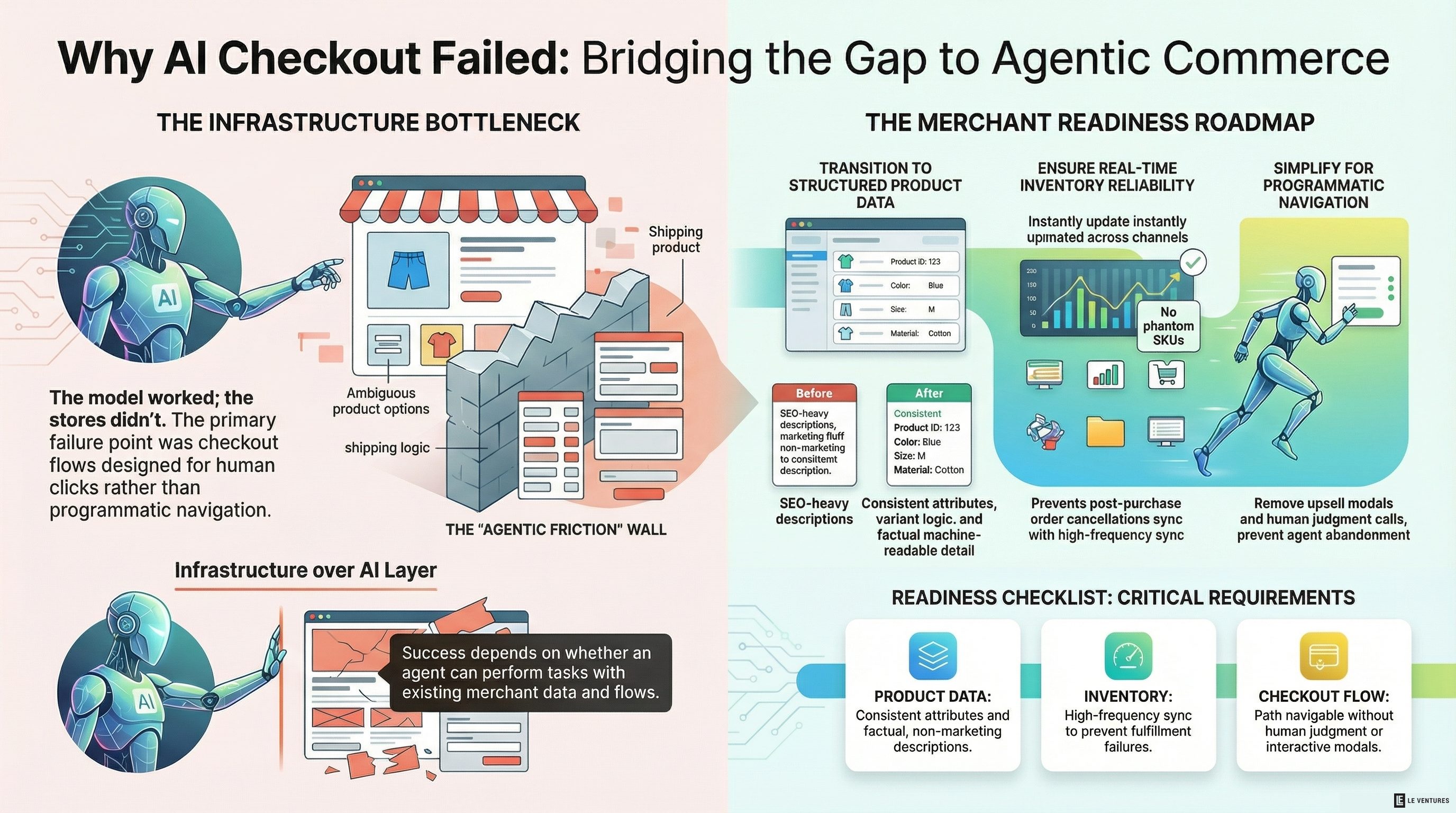
The Modern Retail post-mortem on Instant Checkout identified a few recurring failure points: trust gaps (customers weren’t confident the AI was buying the right thing), accuracy problems (product descriptions and variants not translating cleanly to AI-readable data), and merchant readiness (checkout flows that were designed for humans clicking around, not agents navigating programmatically).
That last one is the most important. The model worked. The commerce infrastructure didn’t.
AI agents trying to complete purchases ran into the same friction a confused first-time shopper would - ambiguous product options, unclear shipping cost logic, checkout flows that required human judgment at too many steps. Except a confused shopper can squint and figure it out. An agent either gets clean, structured signals or it fails.
This is the lesson: the bottleneck in agentic commerce isn’t the AI layer. It’s everything the AI has to touch.
Why Merchant Readiness Is the Real Unlock
We’ve spent the last year watching businesses ask the wrong question about AI commerce. The question everyone asks is “which AI platform should we connect to?” The question they should be asking is “can an AI agent actually do its job with the data and flows we have right now?”
Those are very different questions.
Shopify’s integration with ChatGPT is real. AI shopping agents are coming. But integration at the platform level doesn’t automatically mean your specific store is ready. Being on Shopify doesn’t mean your product data is clean. Being discoverable in ChatGPT doesn’t mean an agent can confidently complete a purchase for one of your products without breaking.
Three things determine whether your store converts in an agentic commerce world:
1. Product data quality
AI agents are making purchase decisions based on your product titles, descriptions, attributes, and variant logic. If those are inconsistent, incomplete, or written for SEO rather than clarity, the agent either gets it wrong or abandons the transaction.
“Blue Relaxed Fit Tee - S/M/L/XL” is human-readable. An agent needs structured color attributes, structured size options, and a description that accurately conveys fit and material. If your catalog was built by a mix of vendors, seasonal interns, and imported CSVs, it probably has all three problems at once.
Fix this now. Audit your top 20% of SKUs by revenue. Are the titles accurate? Are the variants structured consistently? Are the descriptions factual, not just marketing copy?
2. Inventory signal reliability
One of the fastest ways to destroy trust in AI-assisted checkout is to complete a purchase and then send a cancellation email because the item was out of stock. Agents can’t handle that gracefully. Customers blame the AI, then they blame your brand.
Real-time, accurate inventory data is non-negotiable for agentic commerce to work. If your inventory sync runs every 12 hours, or if you have a backlog of phantom SKUs that show as available, you are a ticking clock for bad AI-assisted purchase experiences.
3. Checkout flow navigability
Standard checkout flows were designed for humans. They include upsell modals, address verification steps with ambiguous error states, coupon fields that sometimes work, and shipping calculators that require interaction to reveal costs.
An AI agent navigating that flow is going to hit friction. Some of it is fine - agents can handle structured steps. But if your checkout requires a human to make judgment calls at multiple points, the agent either gets stuck or makes assumptions. Neither outcome is good.
The stores that will convert well in agentic commerce are the ones with predictable, clean checkout paths. That means minimizing required interactions, surfacing shipping costs early, and eliminating unnecessary confirmation steps.
What This Means If You’re Planning Ahead
Agentic commerce isn’t a switch that flips on one day. It’s a gradual shift in how purchases get initiated. ChatGPT’s Instant Checkout stumble is just the first visible friction point in what will be an ongoing process of AI systems learning to work with existing merchant infrastructure.
But here’s the practical implication: the stores that fix their data and flows now will have a real conversion advantage when this lands at scale. It’s not a moonshot infrastructure project - it’s operational hygiene that benefits your existing conversion rate today while also positioning you for what comes next.
Run through this checklist:
- Are your product attributes structured consistently across your catalog?
- Do your product descriptions contain accurate, factual detail - not just aspirational copy?
- Is your inventory synced frequently enough that AI-initiated purchases won’t create fulfillment problems?
- Is your checkout flow navigable without human judgment calls at key steps?
- Do you have an API or clean data feed that an AI agent could actually read?
If you’re answering “I’m not sure” to more than two of those, you have work to do before agentic commerce becomes a meaningful channel.
The Broader Point
OpenAI didn’t fail on Instant Checkout because their model was bad. They hit the same wall every technology company hits when it tries to automate something that touches real-world commerce: the underlying data and processes were built for a different paradigm.
The AI is only as useful as the infrastructure it has to work with. That’s true for internal AI implementations - which is what we work on with enterprise clients every day - and it’s equally true for AI-driven commerce.
The brands that will win in this next phase aren’t necessarily the ones on the most sophisticated AI platforms. They’re the ones with clean data, reliable operations, and checkout flows that don’t require a human to untangle.
That’s a solvable problem. It just requires actually solving it before you need it.
If you’re not sure whether your store is set up to take advantage of AI commerce - or if you’re wondering where your operations have gaps that AI can’t navigate - Le Ventures offers a free AI readiness audit. We’ll tell you exactly where you stand and what’s worth fixing first.