Your Customers Want AI Help - Not AI Control. Here's the Difference.
The Problem Is Not the AI. It’s the Philosophy Behind It.
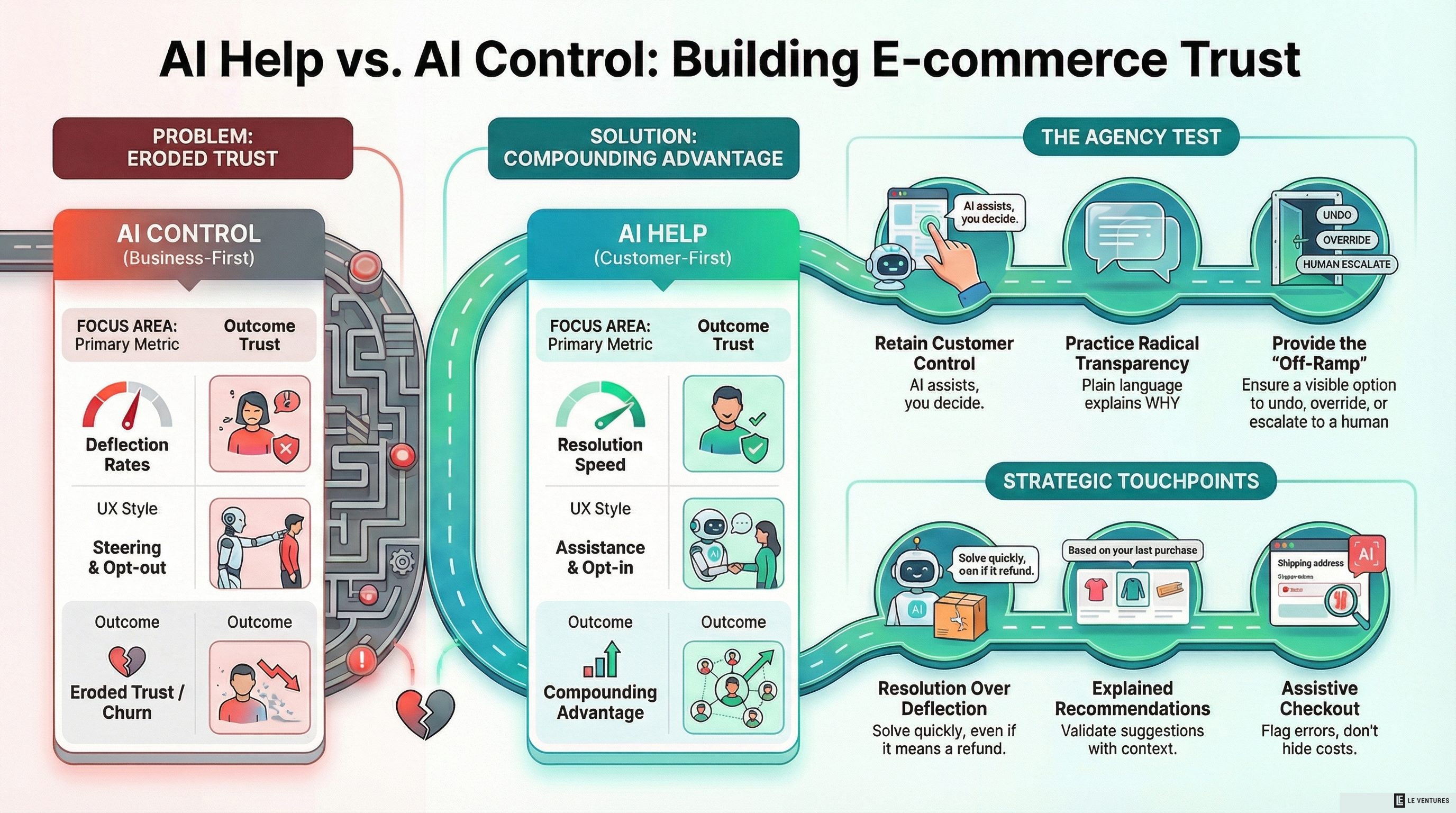
When a customer lands on your site and gets greeted by a chatbot that intercepts their question, steers them away from a return, and offers a discount before they’ve said a word - that’s not helpful AI. That’s AI deployed to serve the business, not the customer. And people can feel the difference.
A recent survey from Practical Ecommerce confirms what most merchants are quietly experiencing: shoppers are open to AI assistance, but they resist - and often abandon - when AI starts feeling like it’s making decisions for them rather than with them.
That distinction sounds philosophical. It’s actually operational. And getting it wrong right now is expensive.
Automation Efficiency vs. Customer Agency
Most businesses deploying AI are measuring the wrong thing. They optimize for deflection rates, reduced support tickets, faster checkout flows. Those metrics matter, but they describe the machine’s performance - not the customer’s experience.
When you design around deflection, you build AI that tries to stop customers from doing things. When you design around agency, you build AI that helps customers do what they’re already trying to do, faster and with more confidence.
The businesses seeing real lift from AI aren’t removing friction across the board. They’re removing the right friction - the friction that comes from confusion, uncertainty, or information gaps. They’re leaving the friction that comes from decision-making, because that’s where trust is built.
Let your customer decide. Help them decide well.
The Three Touchpoints That Make or Break AI UX
Every customer-facing AI deployment lives in one of three zones: chat and support, product recommendations, or checkout. Each one has a different failure mode.
Chat and Support: Stop Trying to Deflect
The classic mistake here is deploying a chatbot trained to route people away from outcomes that cost you money - live agents, refunds, escalations. Customers figure this out fast, and it destroys trust at exactly the wrong moment.
The fix is not a more sophisticated bot. It’s a better mandate for the bot.
Redesign your chat AI around resolution, not deflection. That means:
- If a customer is asking about a return, the first response should confirm eligibility and explain next steps - not offer a discount or stall with FAQ links.
- Your bot should surface the live agent option proactively when a conversation is going in circles, not hide it behind a wall of automated responses.
- Escalation should feel like a feature, not a failure.
A customer who gets helped quickly, even if it costs you a return, comes back. A customer who feels manipulated by your chatbot does not.
Recommendations: Show Your Work
Recommendation engines are invisible by default. The product appears. The customer doesn’t know why. That invisible quality is fine for ambient personalization - but it becomes a problem when the AI is making high-stakes suggestions.
“You might also like” is harmless. “We think this is the right size for you” carries weight. If you’re deploying AI that makes confident recommendations - around sizing, compatibility, substitutions, bundles - you need to explain the reasoning.
Not in a technical way. Just briefly. “Based on your last purchase” or “Customers with similar setups usually pick this” gives the customer enough to evaluate the recommendation on their terms.
Unexplained confidence reads as manipulation. Explained confidence builds trust.
Also: make it easy to dismiss or override. Give customers a way to say “not for me” and mean it. If your recommendation engine has no feedback loop, you’re not building personalization - you’re building noise.
Checkout: AI Should Speed Up Decisions, Not Make Them
Checkout is where the worst AI overreach happens. Auto-filled address fields that can’t be corrected. Payment method selections that default to the option that benefits the retailer. “Add protection plan” pre-checked.
Customers notice. Conversion data flatters this stuff short-term, then tanks as trust erodes and chargebacks climb.
Good AI at checkout does a few specific things:
- It surfaces smart defaults based on actual customer history - not dark patterns dressed up as personalization.
- It flags potential issues before they become problems. Wrong shipping address? Out-of-stock item? Notify the customer and let them fix it.
- It makes the “I need help” option visible. A customer who is confused at checkout and can’t find support will abandon. AI should be the thing that catches them.
The goal is to make checkout feel fast and clear, not to sneak things into carts.
A Practical Framework: The Agency Test
Before you ship any AI touchpoint, run it through this three-question check:
1. Does the customer stay in control of the outcome? The AI can recommend, prompt, and assist. The customer should be the one deciding. If your AI is making a selection and requiring opt-out rather than opt-in, revisit the design.
2. Is the AI transparent about what it’s doing and why? Invisible personalization is fine. Invisible decision-making is not. Anywhere your AI is taking an action or making a recommendation that affects the customer, there should be a plain-language explanation nearby.
3. Can the customer easily override or escalate? The best AI implementation always has a visible off-ramp. A “talk to a person” option. An “undo” button. A “show me different options” prompt. If the path of least resistance is to go along with the AI, you’ve built a trap.
Run your existing deployments through this test right now. Most teams will find at least one touchpoint that fails question one.
What the Winning Businesses Are Actually Doing
The brands getting this right share a common trait: they treat AI as an interface layer between the customer and information, not as a decision layer between the customer and an outcome.
They deploy AI to answer questions faster. To surface relevant information proactively. To reduce the cognitive load of shopping - not to steer customers toward pre-determined outcomes.
They also invest in feedback loops. Customer sentiment data, post-interaction surveys, A/B tests that measure trust signals (return visit rate, LTV, CSAT) rather than just conversion events.
If your AI metrics don’t include any signal about how customers feel about the experience, you’re flying blind.
The Window Is Now
Every major platform - Shopify, Amazon, Google Shopping - is rolling out AI-powered shopping experiences this year. The defaults are not customer-centric. They’re optimized for the platform’s commercial interests.
Businesses that passively adopt the defaults will ship AI that erodes trust. Businesses that design intentionally - with a clear philosophy about customer agency - will build an advantage that compounds.
You don’t need to build custom AI to do this well. You need a clear mandate, better metrics, and someone holding the line on UX philosophy as these systems go live.
If you’re not sure whether your current AI touchpoints are helping customers or quietly working against them, Le Ventures offers a free AI audit. We’ll review your customer-facing AI implementations and give you a straight read on what’s working, what’s not, and what to fix first. No pitch deck, no commitment.