Your prompts don't matter
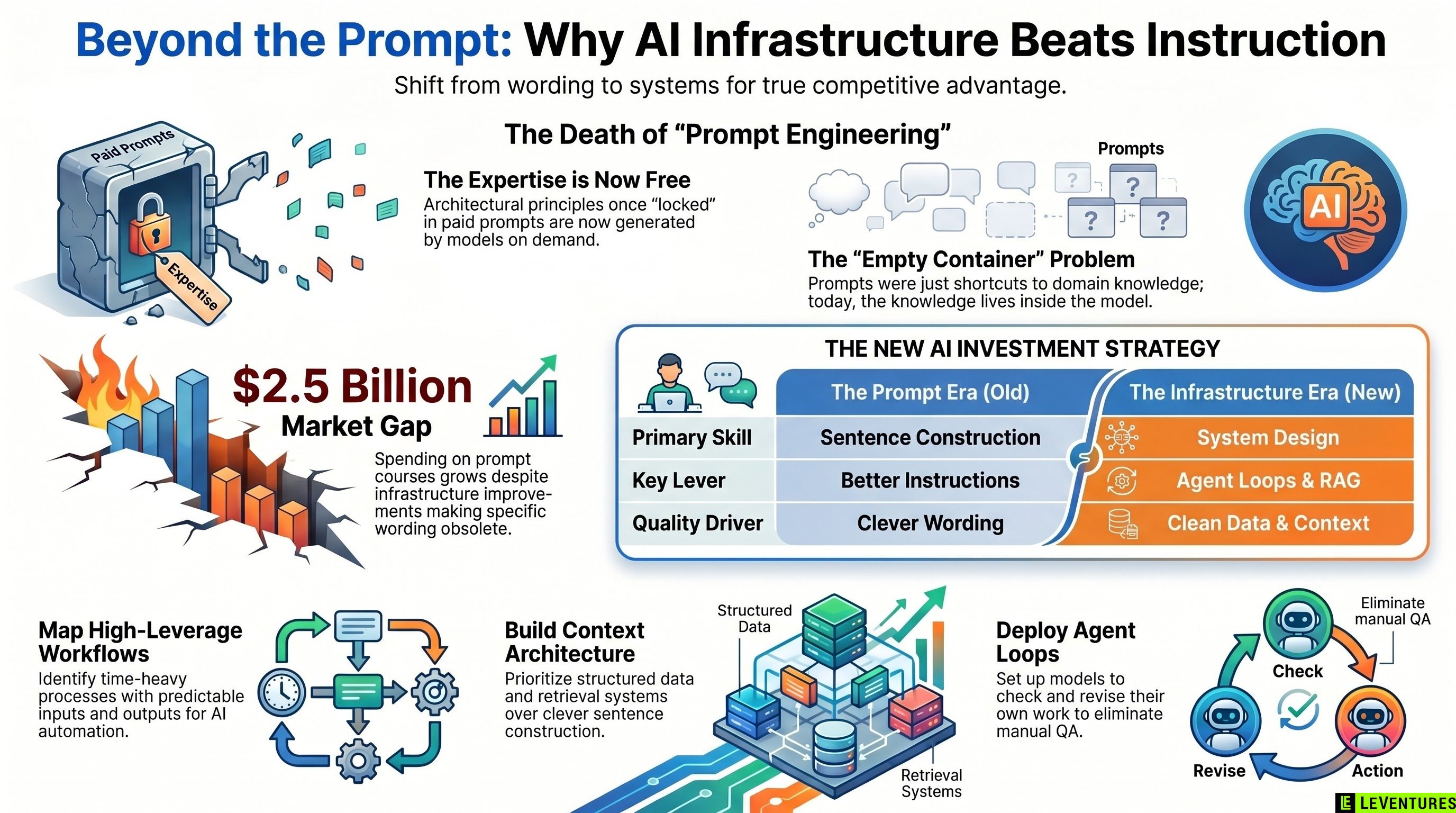
If you or someone you know is paying for prompts, stop. This article explains why and where to invest instead.
The Real Reason Prompts Worked
In 2024, prompts sold because they worked. Not because the wording was clever, but because buying a prompt meant buying domain expertise you didn’t have.
Here’s what actually happened: a non-technical founder pays $200 for a “Build a SaaS App” prompt. They paste it in, and the output is dramatically better than anything they’d get from asking on their own. It feels like magic. They tell their friends. The prompt seller makes another sale.
But look at what was inside that prompt. It wasn’t fancy language. It was decisions: use NoSQL for schema flexibility, structure for multi-tenancy from day one, implement logging before business logic. Those aren’t writing tips. Those are architectural principles that took engineers years to learn the hard way.
The buyer wasn’t paying for a prompt. They were paying for a shortcut to expertise they didn’t have. The prompt was just the container.
That Container Is Now Empty
Fast forward to 2026. That same non-technical founder sits down to start their SaaS build. Instead of buying a prompt, they type: “Generate a detailed expert prompt for building a scalable SaaS app. I’m non-technical.”
The model spits out the same architectural guidance. Multi-tenancy. Logging strategy. NoSQL tradeoffs. Everything that was “locked” in the $200 prompt is now available on demand, for free, in seconds.
Or they skip the meta-prompt entirely and just describe the app they want to build. The model fills in the gaps. Because the knowledge was never in the prompt. It was always in the model. The prompt was a middleman, and the middleman got cut out.
This isn’t about models getting smarter in isolation. The real change is structural.
What Actually Moved the Lever
Better models helped, but that’s not the full story. The breakthroughs that made prompt engineering obsolete are the systems built around the models.
Harnesses that manage input and output flows. Agent loops that let models iterate, check their own work, and refine outputs without hand-holding. Plan mode, where the model reasons through a problem before it executes. Context windows large enough to hold an entire codebase or document library. Retrieval systems that surface the right information at the right moment.
These aren’t prompt improvements. They’re infrastructure improvements. And they matter more than any instruction you can write.
The lever moved from “better instructions” to “better infrastructure.” Writing a sharper prompt is like optimizing the handwriting on a letter when you should be building an email system.
The Market Hasn’t Caught Up
Here’s the uncomfortable part: the prompt market is still worth over $2.5 billion and actively growing. Courses, marketplaces, templates, certifications. People are still buying, and sellers are still selling.
That gap between what the market is selling and what actually works has never been wider.
This isn’t a fading myth on its way out. It’s an actively reinforced one, because the feedback loop is slow. Someone buys a prompt course, gets better outputs than before, attributes the improvement to the prompts, and recommends the course to someone else. The variable they’re missing is that outputs improved because they started thinking more carefully about their inputs - not because the specific words were magic.
The businesses winning with AI right now are not the ones with the best prompts. They’re the ones who built smarter systems around the model. They designed agent loops that catch errors before a human has to. They built retrieval layers that pull relevant context automatically. They invested in system design, not sentence construction.
Where to Put Your Money Instead
If you’ve been spending on prompts or prompt courses, here’s a more useful allocation.
First, map your actual workflows. Most companies using AI are throwing it at random tasks. Before you optimize anything, understand which processes eat the most time and have the most predictable inputs and outputs. Those are your targets.
Second, invest in context architecture. The biggest gains in AI output quality come from giving the model the right information, not from asking more cleverly. That means structured data, good retrieval, and clean inputs.
Third, build or buy a harness. A harness is the layer that sits between your prompts and your outputs - managing flow, handling errors, enforcing structure. Off-the-shelf options exist. Custom ones work better for specific workflows. Either way, this is where leverage lives.
Fourth, use agent loops for anything iterative. If a task requires review-and-revise cycles, don’t do the revision yourself. Set up a loop where the model checks its own work against defined criteria. This alone can replace hours of manual QA.
None of this requires a developer on staff full time. It requires understanding what the building blocks are and where to apply them.
The Knowledge Is Already There
The expertise that used to live in expensive prompts is now accessible to anyone willing to ask for it directly. What separates the businesses getting real results from those spinning their wheels isn’t the quality of their instructions. It’s whether they’ve built a system worth giving those instructions to.
Know someone wasting money on prompt courses? Send them this article.