Where to Actually Start With AI in Your Business (Most People Get This Wrong)
Most business owners asking “where do I start with AI?” aren’t asking the wrong question. They’re just asking it too late.
They’ve already watched a demo, signed up for a tool, maybe hired someone to “do AI stuff.” Three months later, they have a ChatGPT subscription nobody uses and a Zapier workflow that breaks every Tuesday.
The problem isn’t AI. The problem is starting with the tool instead of starting with the work.
The First Question Isn’t “What Tool Should I Use?”
It’s: What does my team do repeatedly that takes more time than it should?
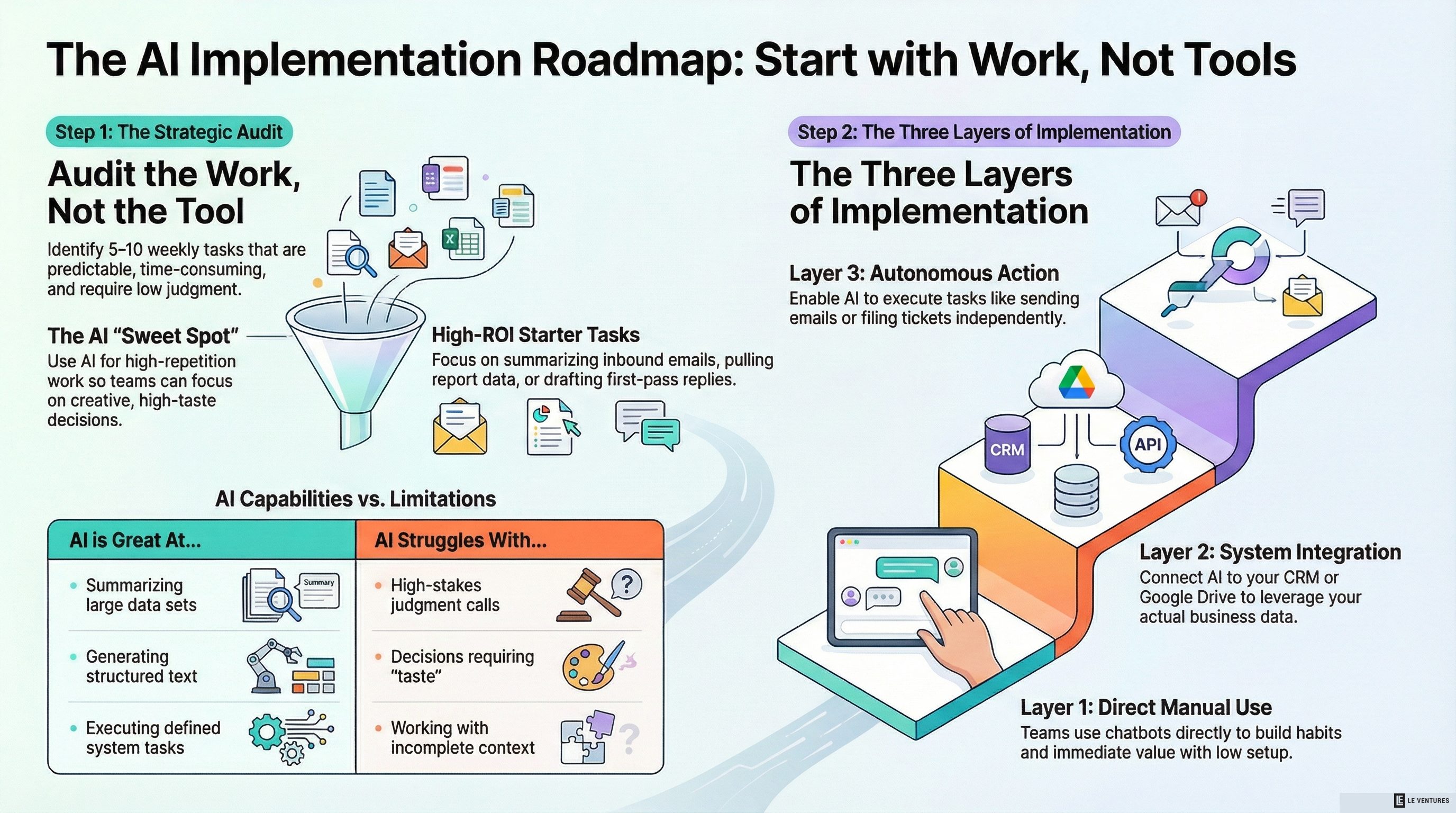
That’s the whole audit. Before you look at a single vendor or sit through a single demo, make a list. Pick five to ten things your team does every week that are time-consuming, predictable, and don’t require a gut-call from scratch each time.
Here are examples that come up constantly:
- Summarizing inbound emails or support tickets before routing them
- Pulling order data and building a weekly report
- Drafting first-pass replies to common customer questions
- Checking inventory against sales trends
- Creating briefs or first drafts from a set of inputs
These aren’t glamorous. They’re not conference keynote material. But they’re where the actual ROI is - and where you should start.
What AI Is Good At (and What It Isn’t)
AI is genuinely good at three things right now:
- Reading and summarizing information
- Generating structured text from inputs
- Executing defined tasks across software systems
It is not good at judgment calls with incomplete information. It struggles with creative decisions that need taste and business context. And you should never fully automate anything where the cost of being wrong is high and no human is watching.
This matters because the two biggest mistakes business owners make are opposite extremes. Either they dramatically underuse AI - treating it like a fancy search bar. Or they dramatically overuse it - automating decisions that should have a person involved.
The sweet spot is in the middle. Use AI to eliminate the low-skill, high-repetition work so your team can focus on the stuff that actually requires them.
The Three Layers of AI Implementation
When you’re building this out, there are three distinct layers. Most businesses skip straight to layer three. That’s why things fall apart.
Layer one: AI as a tool your team uses directly.
This is Claude, ChatGPT, Perplexity - whatever. Your team opens it, asks a question, gets an answer. Low setup cost. Immediate value. Easy to measure. Start here. Get your team comfortable. Build the habit.
Layer two: AI connected to your existing systems.
This is where AI stops being a standalone tool and becomes part of your workflow. Your AI assistant can read from Google Drive, query your store, pull from your CRM. It gives answers based on your actual data instead of making things up.
This requires some setup - connecting accounts, setting permissions, picking the right platform. But it’s not engineering-heavy if you use the right tools.
Layer three: AI that takes action on its own.
This is where AI doesn’t just answer questions - it does things. Creates the order. Sends the email. Updates the record. Files the ticket. This is where the real operational leverage is.
It’s also where things go wrong if you skipped layers one and two.
Most vendors want to sell you layer three on day one. Don’t buy it until you’ve spent real time in layers one and two. You need to understand your data quality, your edge cases, and exactly where a human needs to stay in the loop.
A Simple Way to Think About It
AI implementation isn’t a product purchase. It’s a process redesign.
The businesses getting the most out of AI right now didn’t start with the flashiest tools. They started by asking honest questions about where their team’s time was going - and then worked backward to figure out what AI could take off their plate.
Start small. Measure the time saved. Then layer up.
If you’re not sure where to start or want a second set of eyes on your current setup, Le Ventures offers a free AI audit for businesses ready to cut through the noise. We’ll look at your workflows, identify the highest-leverage opportunities, and give you a clear path forward - no sales pitch required.