Why Your Sales Events Are Training Customers to Wait
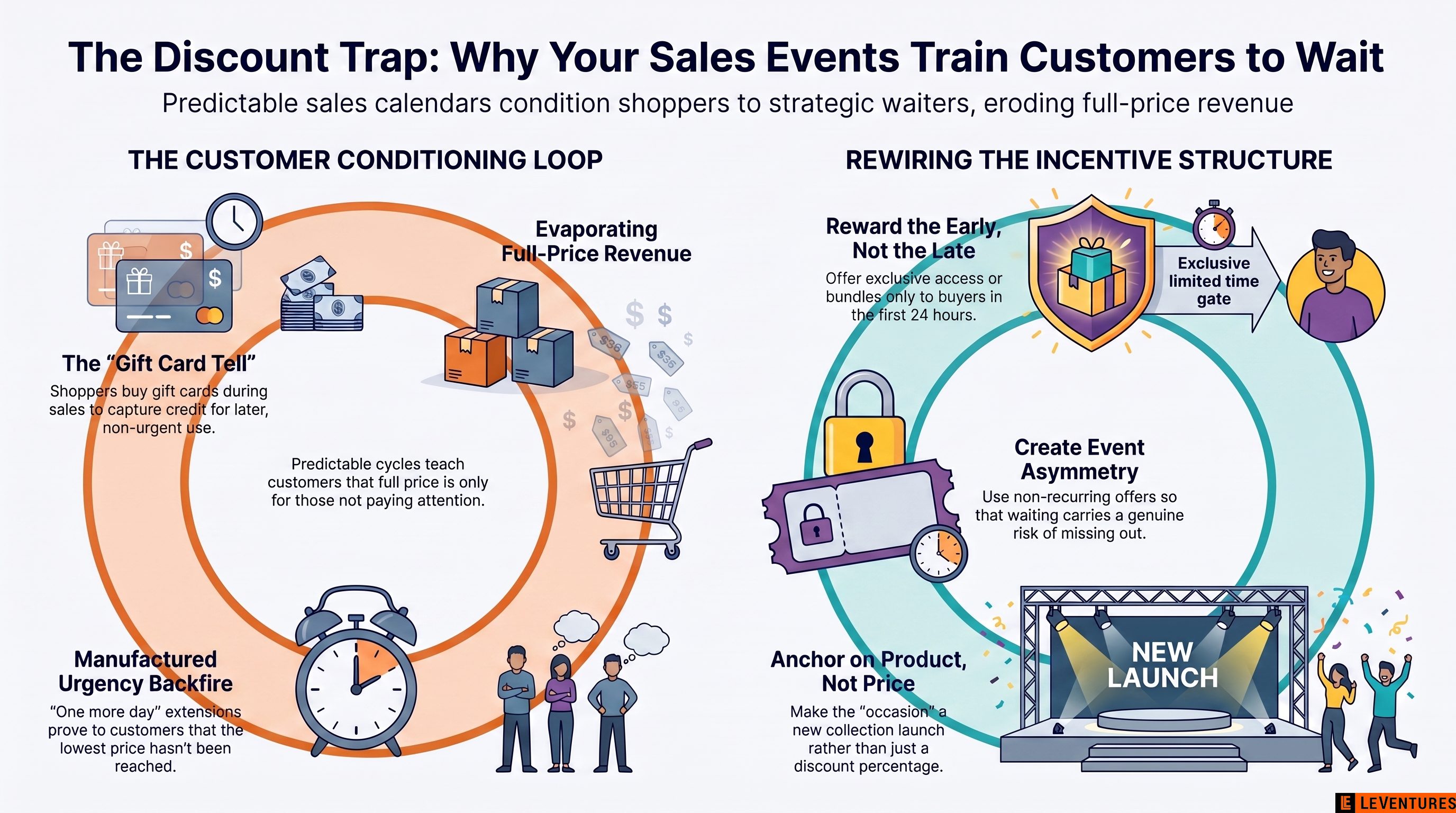
Prime Day opened with shoppers buying gift cards. Not the big-ticket items the deals were built around - gift cards. Consumers loading store credit to use later, stocking essentials they needed anyway, and sitting on their hands for anything they actually wanted to buy.
That behavior is not confusion. It is strategy. And it is the clearest sign yet that your customers have learned to play your promo calendar better than you have.
What the Gift Card Tell Is Actually Saying
When a shopper buys a gift card during a sale, they are not getting excited about your discounts. They are using your sale event as a savings mechanism - capturing the credit now so they can spend it on their own timeline, at a price point they trust, without committing to anything specific.
That takes a certain sophistication. It requires knowing that deals will repeat, that the launch-day urgency is manufactured, and that holding out is almost always rewarded. It requires a customer who has been trained, over multiple cycles, that waiting is the rational move.
You trained them. Every time you ran a deeper discount to clear Q4Q4The fourth fiscal quarter of the year, covering October through December, which most retailers treat as peak promotional and revenue season. inventory, every time you sent a “one more day” extension email, every time you offered a bigger flash saleflash saleA heavily discounted sale lasting only a few hours, designed to pressure buyers into deciding before the offer disappears. six weeks after your “biggest sale of the year,” you added another data point to their mental model: the price is not real until it goes lower.
The Conditioning Loop Nobody Wants to Name
There is a standard argument that promotional events drive volume, clear inventory, and acquire new customers at acceptable cost. That argument is not wrong in the short term. The problem is the side effect it ignores.
Repeat promotional cycles teach your best customers - the ones paying attention, the ones worth keeping - that full price is for people who are not paying attention. They stop buying between events. They bookmark items and wait. They set price alerts. They load gift cards during your sale to use on their schedule, not yours.
You do not notice this at first because the event numbers look fine. What you do not see is the full-price revenue that evaporated in the weeks before and after, because your customers are saving themselves for the next event they know is coming.
This is not a Prime Day problem. Prime Day is just the clearest example right now because it is big enough to show the pattern in aggregate. The same dynamic is running through every brand promo calendar that leans on recurring discount events: holiday sale, end-of-season sale, Black Friday, Cyber Monday, and whatever else fills the gaps. Each one is another training repetition.
What Q4 Planning Actually Requires This Year
The operators who head into Q4 with the same playbook - bigger sale, deeper discount, more email cadenceemail cadenceThe planned schedule and frequency with which marketing emails are sent to customers, particularly around a promotional event. around the event - are going to be competing on the terms their customers have already mastered. The customers will wait longer, convert on less, and return at higher rates because they bought things they only sort-of wanted because the discount was compelling, not because they needed the product.
The question worth asking before locking in the holiday promo calendar is not “what discount drives the most conversions” but “what am I teaching customers about when to buy from me?”
A few places to start:
- Reward early, not late. Exclusive access, limited bundles, or added value for buyers in the first 24 hours changes the incentive structureincentive structureThe combination of rewards and costs that shapes which behavior a person finds most rational to choose.. The customer who waits gets the crowd; the customer who buys early gets something the waiters do not. That is a different conditioning loopconditioning loopA cycle where repeated patterns of reward or reinforcement train a person to form a reliable expectation, drawn from behavioral psychology's account of how consistent outcomes shape future choices..
- Anchor on product, not price. Promotions built around a product launch, a new collection, or a meaningful reason to buy now have a logic that does not teach deferral. The sale is the occasion, not the discount.
- Create asymmetry between events. If every promo looks like every other promo, customers learn to wait for the best one. If some events offer things that do not recur - specific bundles, specific access, specific limited stock - waiting carries actual risk.
None of this means abandon discounting. It means understanding what behavior you are reinforcing with every campaign you run, because your customers absolutely understand it.
The shoppers loading gift cards on day one of Prime Day are not being passive. They are running a disciplined strategy. The question is whether your Q4 calendar gives them any reason to change it.