What Really Happens When Carts Become Universal
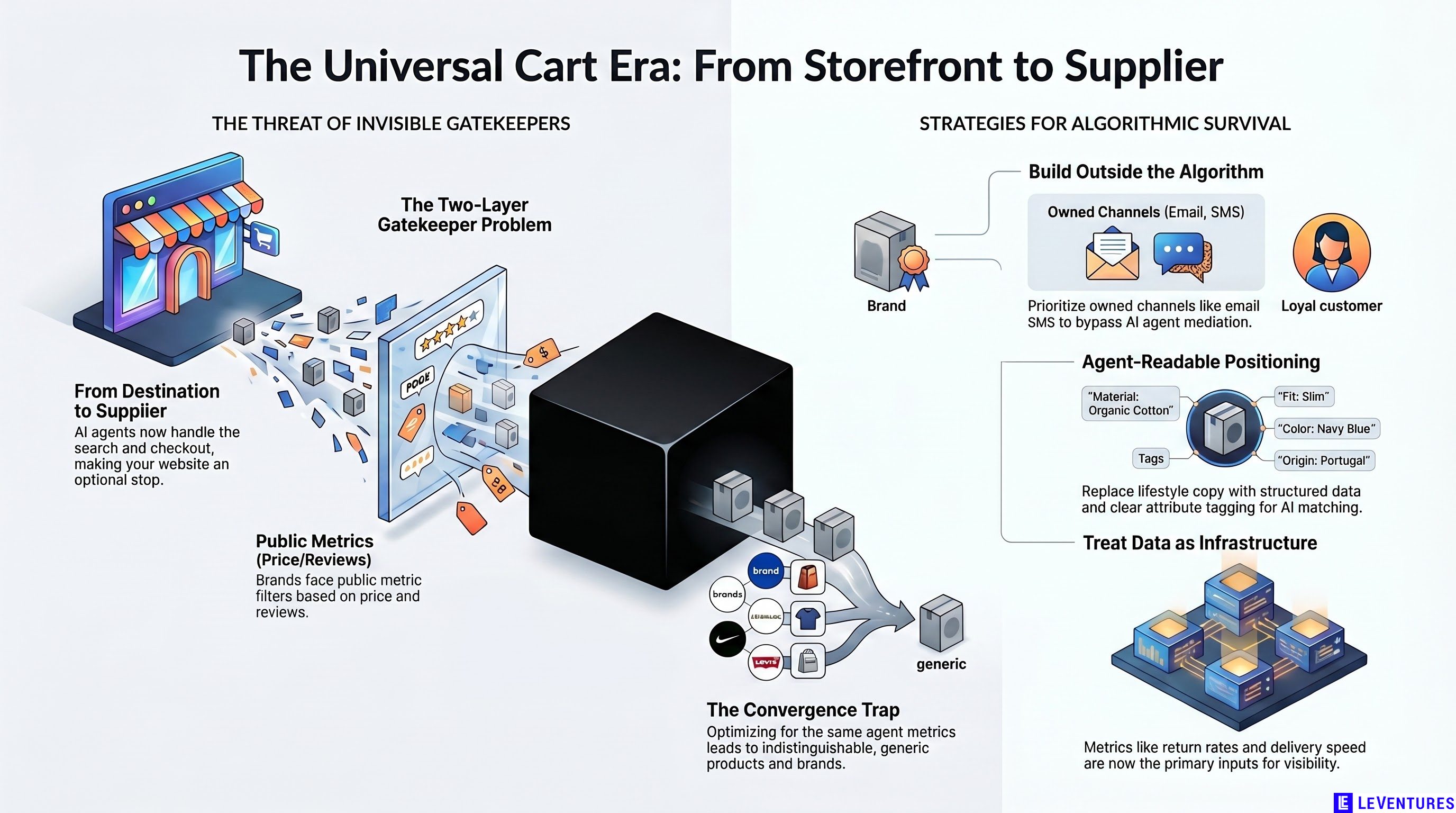
Google’s Universal Cart launches this summer, and most businesses are treating it like a UX update. It isn’t. It’s a structural shift in who owns commerce - and the implications run deeper than most people are thinking through.
Here’s what’s actually changing: customers won’t need to visit your site. An AI agent, operating within spending limits the user sets, can find, evaluate, and purchase on their behalf. Google handles the cart, the checkout, the payment data, and the purchase history. You ship the product. That’s the new relationship.
You’ve just become a supplier to Google’s ecosystem.
The Two-Layer Gatekeeper Problem
There are two separate visibility problems, and most businesses will only notice one of them.
The first is public: search rankings, review scores, return rates, price competitiveness. These are the metrics agents use to filter the field. Big brands with established data profiles dominate here. Small brands, new entrants, and niche products start invisible.
The second is private: the personalized recommendation layer that decides what the agent actually surfaces to a specific user. You can’t see this algorithm. You can’t appeal a decision. You won’t know why the agent chose a competitor over you. There’s no recourse and no transparency.
Traditional SEO gave you something to optimize against. This doesn’t.
What Dies When Agents Mediate All Buying
Discovery as a competitive mechanism is effectively gone. The entire history of how niche brands broke through - word of mouth, a viral moment, a cult following built through genuine weirdness - depends on humans finding things through non-algorithmic paths. Agents don’t browse. They match.
Brand storytelling becomes harder to monetize. If the agent is deciding based on return rates and delivery speed, your origin story doesn’t factor in. Emotional resonance doesn’t have a clean data field.
The “misfit becomes winner” path closes. Weird, experimental, or controversial products don’t make it through the filter unless they have enough clean data to get surfaced. And they can’t get enough data without first being surfaced. That loop is hard to break.
The Convergence Trap
Here’s the long-term problem that’s getting almost no attention: when every business optimizes for the same visible metrics, products start to converge.
If agents rank on return rates, everyone designs products that photograph well and set conservative expectations. If they rank on delivery speed, everyone races to the same fulfillment infrastructure. If they rank on review sentiment, everyone writes the same safe copy.
Feature parity becomes the competitive norm. The pressure is relentless and invisible. You don’t feel yourself becoming generic - you feel yourself becoming competitive.
But “competitive” in this system means “indistinguishable.”
Personalization as a Trap
The algorithm knows your customers’ purchase history better than you do. That sounds like an advantage, but it cuts against discovery.
An agent optimizing for what a user has liked before will keep surfacing familiar products. It’s not incentivized to introduce novelty or surprise. It’s incentivized to reduce friction and increase completion rate. Those are different goals.
For businesses that sell replenishment products, this is fine. For businesses that sell something genuinely new or different, it’s a problem. You’re competing against the user’s own history.
What You Can Actually Do
Build outside the algorithm’s reach first. Email lists, SMS subscribers, direct relationships - anything that doesn’t require agent mediation to activate. Your owned channels become more valuable as rented visibility becomes less reliable.
Treat your data like infrastructure. Return rates, satisfaction signals, delivery performance - these aren’t just operational metrics anymore. They’re the inputs that determine whether agents recommend you. Audit them now, before the system is live.
Price for the system you’re entering, not the one you’re leaving. If agents are optimizing on price/performance ratios, your margin strategy needs to account for that. Pure price competition against algorithmic optimization is a race you don’t want to run.
Get specific about who you’re for. Undifferentiated products competing on metrics alone will get squeezed. Highly specific products with a clearly defined customer profile have a better path - especially if that specificity maps to something the user can explicitly tell an agent (“find me a desk for a 6-foot person who works in a small apartment”).
Think about agent-readable positioning. This is early, but worth starting: how would you describe your product to an AI agent in a way that gets matched to the right buyer? Structured data, clear attribute tagging, and unambiguous product descriptions matter more than lifestyle copy.
Watch for agent-to-agent protocols. The emerging space is brands building APIs that agents can query directly - not storefronts, but data endpoints. If this becomes standard, early movers get first-mover data advantages. Keep an eye on it.
The Core Question
Where does your business fit when metrics are the gatekeeper?
That’s not rhetorical. It’s the strategy question every business owner needs to answer before this summer. The brands that survive this shift will have made a deliberate choice about where they compete - not just assumed the game stays the same.
Google isn’t building this to help your business grow. They’re building it to own the commerce layer. That’s not criticism, it’s just useful to be clear about.
The question is what you build in response.
If you want to think through how your specific business fits into this shift, Le Ventures offers a free AI readiness audit - a good place to start before the system goes live.