AI Shopping Is Coming to Every Platform. Shopify Just Got There First.
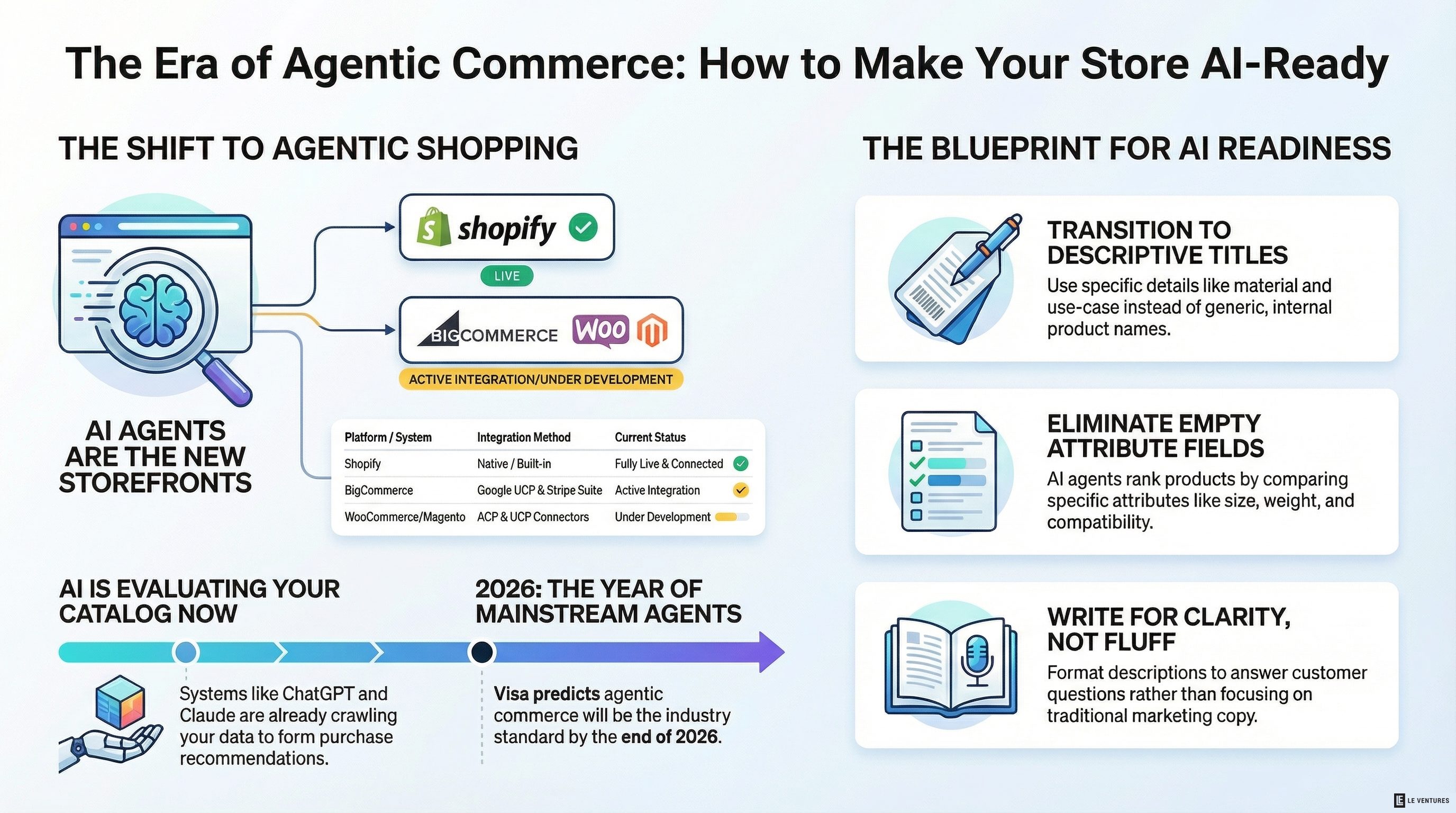
Shopify just turned on Agentic Storefronts for every merchant. Hundreds of millions of ChatGPT users can now find and buy Shopify products without leaving the chat.
If you’re on BigCommerce, WooCommerce, Magento, or another platform - you’re probably wondering: what about us?
The short answer: it’s coming. The longer answer is more interesting - and more urgent than you might think.
What’s Happening Right Now
Shopify got there first because they built it into the platform. Every Shopify store is now connected to ChatGPT, Google AI Mode, Gemini, and Microsoft Copilot by default. No apps, no setup. Products just show up when people ask AI what to buy.
But Shopify isn’t the only one moving.
BigCommerce already supports Google’s Universal Commerce Protocol - an open standard that lets AI agents browse, compare, and purchase products across platforms. They’ve also integrated Stripe’s Agentic Commerce Suite, connecting BigCommerce catalogs to AI agents. Visa has publicly predicted agentic commerce will be mainstream by the end of 2026.
WooCommerce and Magento don’t have native protocol support yet, but independent developers are building ACP and UCP connectors right now. PayPal is expected to launch an ACP server this year that would bring tens of millions of non-Shopify merchants onto AI shopping platforms in one move.
The pattern is clear. Shopify led. The rest of the industry is following. This is not a question of “if” - it’s “when.”
Why the Timing Matters
Here’s the thing most people miss: AI systems are learning about your products right now, whether you’re ready or not.
ChatGPT, Perplexity, Google AI, and Claude are all crawling product pages, reading descriptions, and building an understanding of what you sell. When agentic shopping reaches your platform, the AI already has an opinion about your catalog. If your product data is clean, structured, and clear - you’ll be one of the first to surface. If it’s messy, vague, or incomplete - you’ll get skipped in favor of a competitor whose data made more sense.
This is what happened with Shopify. The stores with strong product data showed up in ChatGPT results immediately when Agentic Storefronts launched. The ones with thin descriptions and generic titles are still invisible.
You have the chance to avoid that by getting your data ready before your platform flips the switch.
What “Ready” Looks Like
We don’t know exactly what agentic shopping will look like on BigCommerce or WooCommerce when it fully arrives. The protocols are still being finalized. The UX will vary by platform.
But we do know what AI needs to recommend your products - because it’s the same across every platform and every AI system:
Clear product titles. “Blue Widget v2” tells AI nothing. “Men’s Lightweight Rain Jacket - Packable, Waterproof, Navy Blue” tells it exactly what you sell and who it’s for.
Complete product attributes. Size, color, material, weight, dimensions, compatibility. Every empty field is a missed signal. AI agents compare products by attributes - if yours are blank, you lose the comparison.
Accurate descriptions that answer questions. Write like you’re answering a customer’s question, not writing ad copy. “Fits laptops up to 15 inches, weighs 2.1 lbs, includes a lifetime warranty” beats “The ultimate bag for the modern professional.”
Real-time inventory. Nothing kills trust in AI shopping faster than recommending an out-of-stock product. Keep your inventory synced.
Clear store policies. Shipping, returns, warranty. AI systems factor these into recommendations. A store with transparent policies ranks higher than one that hides them.
Reviews and social proof. AI systems read reviews. Products with genuine reviews are more likely to surface than products with none.
The Data Cleanup That Pays for Itself
Here’s the best part: none of this is wasted effort.
Cleaning up your product data doesn’t just prepare you for AI shopping. It helps you right now:
- Better SEO. Google’s regular search also rewards structured, detailed product data.
- Higher conversion rates. Customers who find clear, detailed product information buy more often.
- Fewer returns. Accurate descriptions and complete attributes mean fewer surprises.
- Better ad performance. Meta, Google Shopping, and TikTok all perform better when your product feed is clean.
Even if agentic shopping took another two years to reach your platform - which it won’t - you’d still come out ahead from doing this work.
What We Don’t Know
Let’s be honest about the unknowns. We don’t know exactly when every platform will have full agentic shopping integration. We don’t know what the fee structures will look like. We don’t know which AI platforms will drive the most volume for which product categories.
But we know the direction. Every major AI company - OpenAI, Google, Microsoft, Perplexity - is building shopping into their products. Every major ecommerce platform is building the infrastructure to connect. The open protocols (ACP, UCP) exist specifically to make this work across platforms, not just Shopify.
The brands that wait for certainty will scramble to catch up. The brands that prepare now will already be there.
What to Do This Week
You don’t need to wait for your platform to announce anything. Start with these:
- Audit your product titles. Are they descriptive enough that an AI could recommend them based on a natural language question?
- Fill in missing attributes. Go through your catalog and complete every field - especially the ones you’ve been leaving blank.
- Rewrite your top 20 product descriptions. Focus on answering real customer questions instead of writing marketing copy.
- Check your inventory sync. Make sure your availability data is accurate and updating in real time.
- Review your store policies. Are they clear, findable, and complete?
This is a few hours of work that puts you ahead of 90% of your competitors. And when AI shopping arrives on your platform - whether that’s next month or next quarter - you’ll be ready.
Not sure where to start? We’ll audit your product catalog and tell you exactly what needs fixing - for free. No cost, no pressure. Just a clear list of what to do first.