Why Even Google Can't Make AI Agents Work
Google just spent an entire developer conference telling the world that AI agents are the future. Gemini will book your appointments, manage your inbox, handle your travel, coordinate your life. The demos were slick. The vision was grand.
Then The Verge published something that cuts right through it: if Google can’t make AI agents useful, maybe no one can.
That’s not a throwaway take. Google has more data, more compute, more engineering talent, and more consumer surface area than almost any company alive. If they’re still struggling to make agents that reliably do what users ask, that tells you something real about the technology.
But here’s the thing business owners need to understand: Google’s problem is not your problem. And conflating consumer AI agent failures with enterprise AI agent potential is costing companies real opportunities.
Why Consumer AI Agents Keep Failing
Consumer AI agents are being asked to do everything. Book the restaurant, reschedule the dentist, summarize the emails, manage the calendar, reply to texts, remember preferences from six months ago. Across dozens of apps, with unpredictable inputs, for users who have wildly different contexts and intentions.
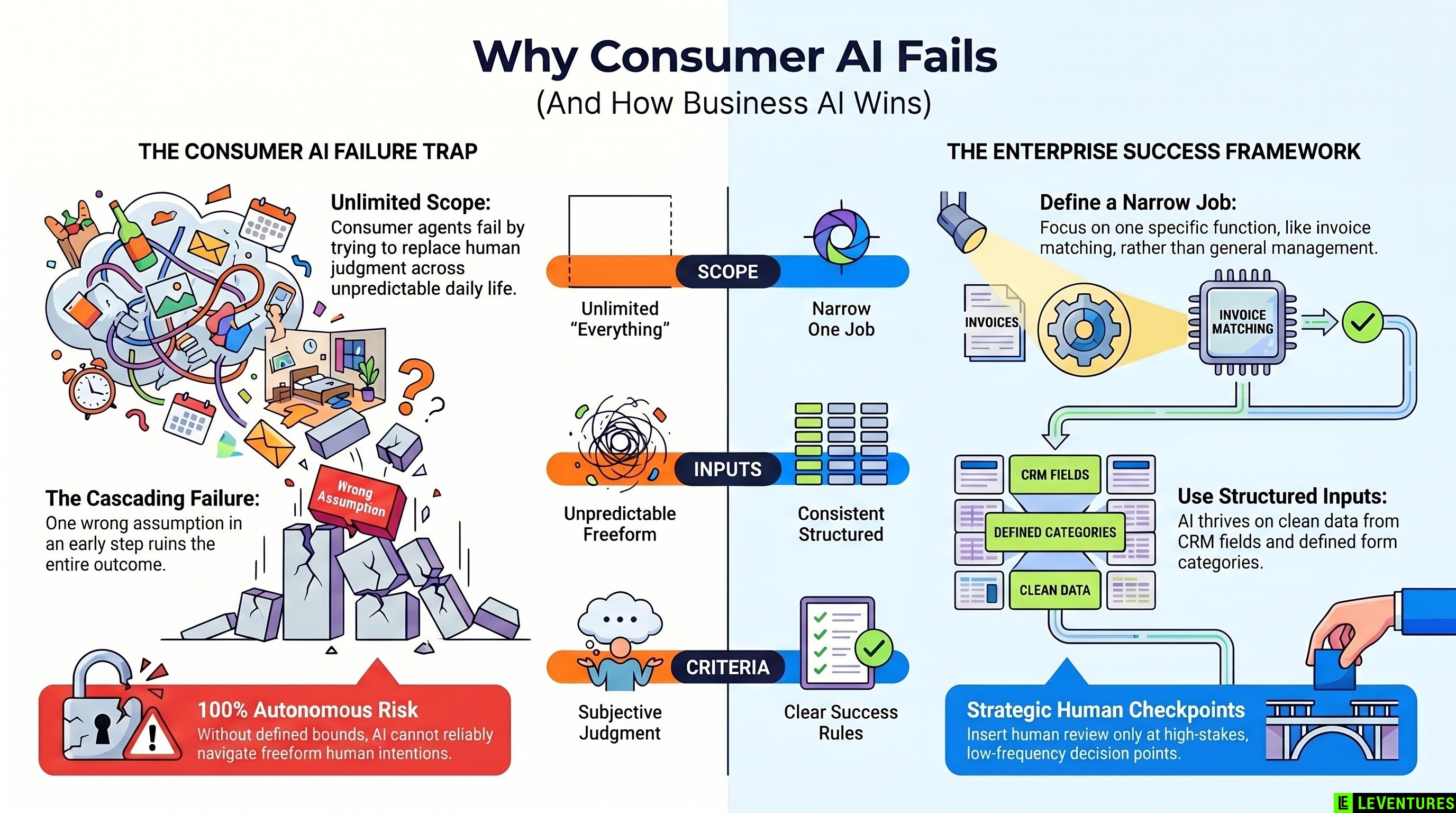
That’s an impossible brief. Not because the AI is bad, but because the scope is unlimited and the failure surface is enormous. One wrong assumption in step two cascades into a completely wrong outcome in step seven. The user asked for “a quick dinner reservation” and ended up with a booking at the wrong location, on the wrong night, because the agent misread a prior conversation thread.
Consumer agents fail because they’re trying to replace human judgment across the full complexity of human life. That’s not an engineering problem you solve by scaling up. It’s a fundamental mismatch between what the technology does well and what the task requires.
What Actually Works in a Business Context
Business processes are not human life. They have defined inputs, predictable structures, and clear success criteria. That’s the environment where AI agents perform.
Take a sales ops team that routes inbound leads. The inputs are consistent: name, company, deal size, source. The rules are explicit: enterprise leads over $50k go to the senior reps, SMB under $10k goes to the automated nurture sequence, everything in between gets a manual review flag. An AI agent can handle that reliably, at volume, without a human touching every record.
Or a customer support operation that categorizes and drafts responses to common inquiries. The agent reads the ticket, identifies the issue type, pulls the relevant policy, drafts a response, and queues it for a human to review and send. The human stays in the loop for the final call. The agent removes 80% of the cognitive load.
Neither of these is trying to do everything. Both have narrow jobs, defined inputs, and a human at the right checkpoint.
The Three Things That Separate Working Agents from Demo Agents
A narrow job. The agent should have one function, not five. If you’re building an agent to handle invoice matching, it handles invoice matching. It does not also manage vendor communications and flag payment disputes and update the ERP. Scope creep kills reliability.
Structured inputs. Agents perform best when they’re working with consistent data. If your agent is pulling from a CRM with clean fields, a ticketing system with defined categories, or a form with required inputs, it has something solid to work with. If it’s parsing freeform emails with inconsistent formatting across thousands of senders, you need more preprocessing before the agent touches it.
Human checkpoints at the right moments. Not humans reviewing every output, which defeats the purpose. Not no humans at all, which breaks trust and causes costly errors. The right design puts a human in the loop specifically at high-stakes, low-frequency decision points. An agent that flags exceptions for human review rather than making all decisions autonomously is far more deployable than one that tries to handle everything.
What to Actually Do With the Google Headlines
Stop reading Google I/O coverage as a signal about whether AI agents are ready for your business. Consumer and enterprise are different problems with different constraints and different maturity levels.
Instead, ask a more grounded question: what repetitive, rules-based process in my operation costs my team the most time and has the most consistent inputs?
That’s your starting point. Not “can AI manage my whole business?” but “can AI handle this one step so my team can focus on the parts that actually need human judgment?”
A accounts payable team spending 20 hours a week on manual matching has a narrow, structured, high-volume problem that’s genuinely solvable right now. A CEO who wants an agent to “run the business while I’m traveling” does not.
The hype-to-reality gap at Google I/O is real. But the lesson isn’t that AI agents don’t work. It’s that they don’t work when the job is too big and the structure is too loose.
Get the scope right and the results are concrete. Le Ventures offers a free audit to help you find where that scope fits in your operation.