Headless Shopify: Is It Worth It for Your Store?
“Go headless” is one of those recommendations that sounds smart in a meeting but rarely comes with enough context to actually make a decision.
Agencies pitch it. Dev shops love it. Shopify built an entire framework around it. But for most ecommerce brands, the question isn’t whether headless is cool - it’s whether it’s worth the tradeoff in cost, complexity, and time.
Let’s break it down.
What Headless Commerce Actually Means
In a normal Shopify store, the frontend - what your customers see - and the backend - where orders, inventory, and payments live - are connected. Shopify controls both. You pick a theme, customize it, and your store looks and works the way Shopify’s system allows.
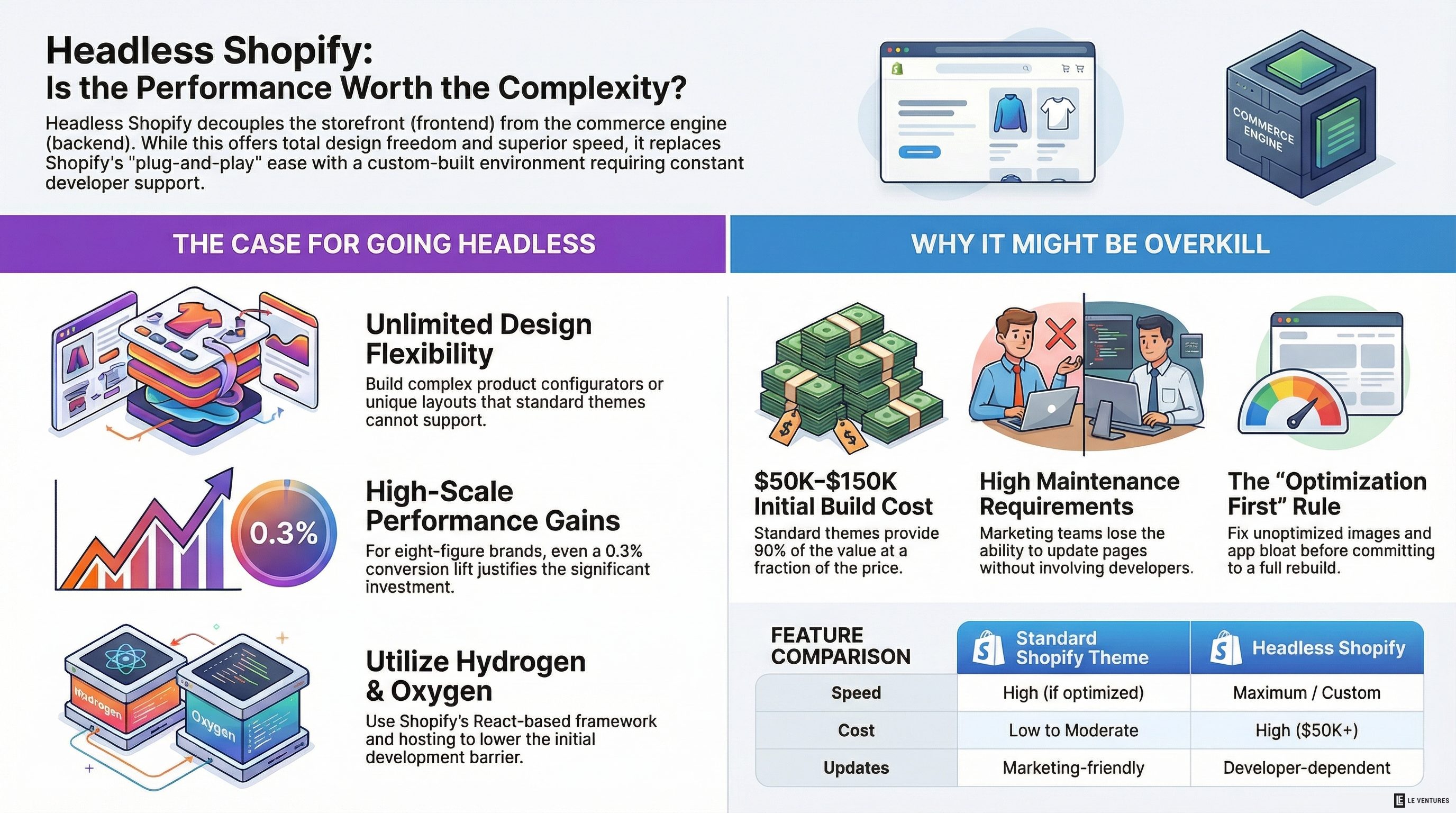
In a headless setup, you separate those two layers. Shopify still handles the backend (checkout, inventory, payments), but you build a completely custom frontend using a framework like React or Next.js. The frontend talks to Shopify through its API.
That’s it. “Headless” just means your storefront is decoupled from the platform that manages your commerce data.
The upside: total control over how your site looks, feels, and performs. The downside: you now have to build and maintain that frontend yourself.
Shopify’s Hydrogen and Oxygen
Shopify saw the headless trend and built tools to make it easier.
Hydrogen is their React-based framework for building custom storefronts. It comes with pre-built components for things like product pages, carts, and collections. Think of it as a starter kit - you still have to build the site, but you’re not starting from zero.
Oxygen is the hosting layer. Instead of deploying your custom frontend to Vercel or AWS yourself, Shopify hosts it on their own infrastructure. It’s integrated with the Shopify admin, so deployments happen from the same dashboard you already use.
Together, they lower the barrier to going headless. But “lower the barrier” and “make it easy” are two different things. You still need developers who know React and modern frontend tooling. You’re still building and maintaining a custom application.
The Performance Argument
This is the biggest selling point, and it’s real - to a point.
A well-built headless storefront can be significantly faster than a standard Shopify theme. Pages load faster because you control exactly what gets loaded and when. There’s no theme bloat, no apps injecting scripts you don’t need, no third-party code slowing things down.
For mobile users especially, this matters. Faster pages mean lower bounce rates and higher conversion rates. Google has been saying this for years, and the data backs it up.
But here’s the thing most people leave out: a well-optimized Shopify theme can also be fast. The performance gap between a bloated Shopify store and a clean headless build is huge. The gap between a well-optimized Shopify theme and a headless build is much smaller.
If your site is slow, the first question should be “why is it slow?” - not “should we go headless?” Often the answer is too many apps, unoptimized images, or a theme that loads everything upfront. Those are fixable without rebuilding your entire storefront.
When Headless Makes Sense
There are real cases where headless is the right call.
You need a highly custom experience. If your brand requires interactions, layouts, or flows that Shopify themes can’t support - think custom product configurators, complex bundle builders, or deeply integrated content experiences - headless gives you the freedom to build exactly what you need.
You’re at significant scale. If you’re doing eight figures or more in annual revenue, the performance and conversion improvements from a headless build can justify the investment. At that scale, even a 0.3% lift in conversion rate is worth a lot of money.
You have the dev team to support it. Going headless means ongoing development work. Theme updates, new features, bug fixes - all of that is on your team now, not Shopify’s theme system. If you have in-house developers or a reliable agency on retainer, this is manageable. If you don’t, it becomes a bottleneck fast.
You’re running multiple storefronts. If you sell in multiple regions or run multiple brands, a headless architecture lets you share a backend while running different frontends for each market. That’s genuinely useful at that level of complexity.
When It’s Overkill
For most brands doing under $5M in annual revenue, headless is overkill.
The cost to build a headless storefront from scratch typically runs $50K-$150K, and that’s before you factor in ongoing maintenance. A high-quality Shopify theme with smart customization costs a fraction of that and gets you 90% of the way there.
If your main problems are slow page speed, poor conversion rates, or a dated design - those are all solvable within Shopify’s theme system. You don’t need to rebuild the house to fix the kitchen.
And there’s an operational cost that gets overlooked: with a standard Shopify theme, your marketing team can update pages, swap images, and adjust copy without developer involvement. Go headless, and many of those changes now require a code deploy. That slows your team down in ways that don’t show up in the initial proposal.
The Questions to Ask
Before you commit to headless, ask yourself:
- What specifically can’t we do with our current setup? If you can’t name specific limitations, you probably don’t need headless.
- Do we have the team to maintain a custom frontend? If the answer is “we’ll hire someone” or “our agency will handle it,” get specific about cost and response times.
- What’s our actual performance problem? Run a Lighthouse audit. Check your Core Web Vitals. If the issue is app bloat or unoptimized assets, fix those first.
- What’s our expected ROI? Headless should pay for itself through higher conversion rates and revenue. If you can’t model that out, it’s hard to justify.
The Bottom Line
Headless Shopify is a powerful option for brands that have outgrown what themes can do. Hydrogen and Oxygen make it more accessible than it used to be. The performance benefits are real.
But it’s an architectural decision with long-term cost and complexity implications. For most ecommerce brands, a well-built Shopify theme - properly optimized, with clean code and fast hosting - will perform well and cost a lot less to maintain.
Don’t go headless because it sounds modern. Go headless because you’ve hit a specific wall that only a custom frontend can solve.
If you’re not sure whether your store needs a headless rebuild or just a better-optimized theme, we can help you figure that out. The free audit looks at your site performance, conversion flow, and tech stack - and gives you a clear answer on where to invest.