Why 93% of Stores Are Spending More on AI This Year
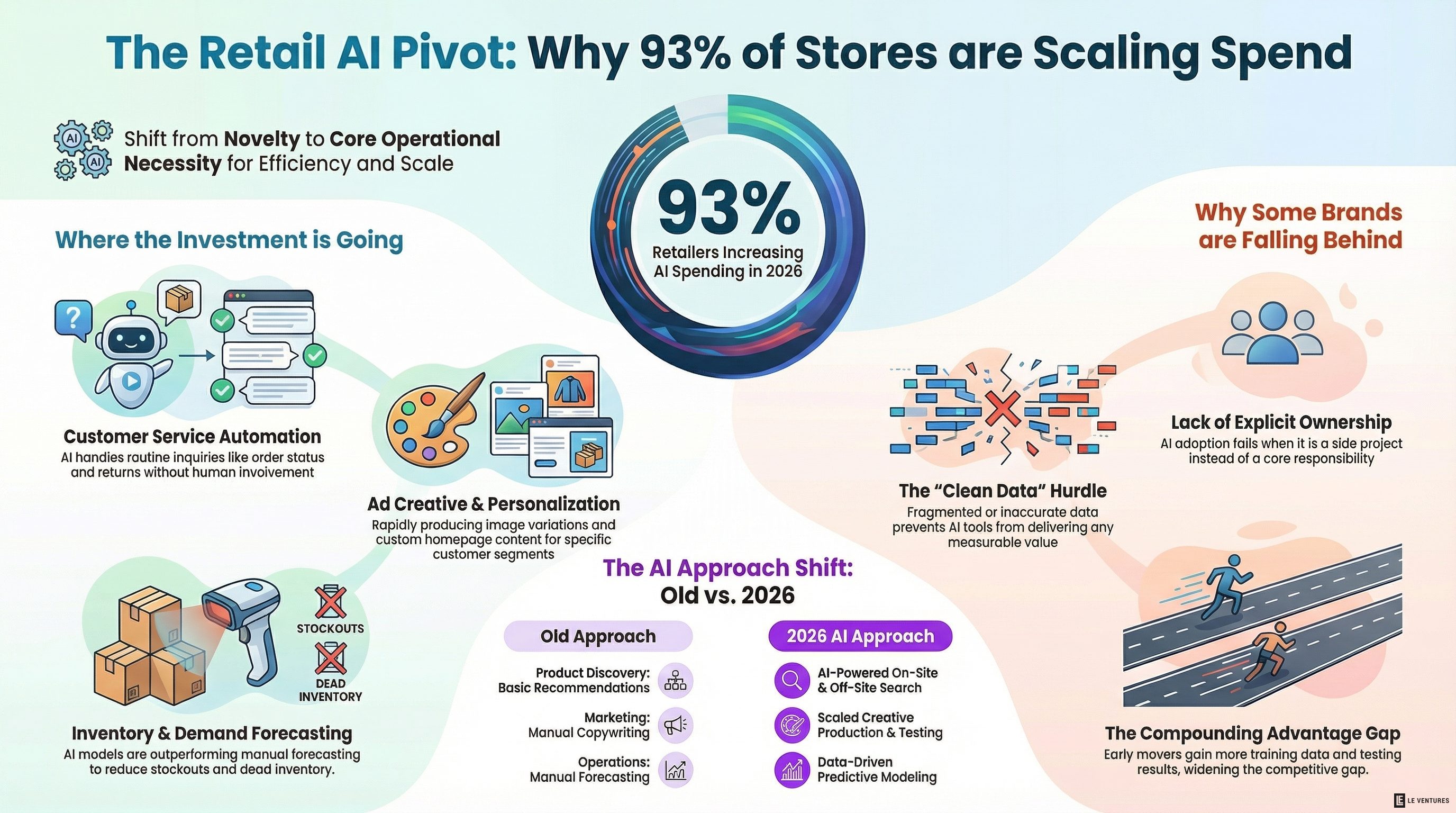
93% of retailers plan to increase their AI spend this year. That number comes from a Salesforce survey of over 1,000 retail executives, and it’s one of the most lopsided statistics we’ve seen in ecommerce in a long time.
When nearly every business in a category is moving the same direction at the same time, it’s worth asking why - and what the 7% who aren’t planning to increase are thinking.
What’s Actually Driving the Spend
A few years ago, AI in ecommerce mostly meant product recommendations. “People who bought this also bought…” That’s still there, but it’s now the least interesting application.
Here’s where the real spend is going in 2026:
Customer service automation. Support is expensive. AI chatbots and automated email responses are handling a growing share of routine questions - order status, returns, size questions - without human involvement. Brands doing this well are cutting support costs while improving response times.
Ad creative production. Writing ad copy, generating image variations, testing headlines - AI tools have gotten fast and good enough that teams are producing more creative in less time. The bottleneck has shifted from production to strategy.
Personalization at scale. Showing different homepage content, email offers, or product recommendations based on what a customer has browsed or bought previously. This used to require enterprise budgets. The cost has come down enough that mid-size brands are doing it now.
Inventory and demand forecasting. Predicting what to stock and when. Getting this right means fewer stockouts and less dead inventory. Getting it wrong is expensive. AI models trained on sales history and external signals are outperforming manual forecasting for most brands that have tried them.
Search - both on-site and off. On-site search has gotten dramatically better with AI. Off-site, brands are starting to pay attention to how they show up in AI-powered search results like ChatGPT and Perplexity.
What the Brands Falling Behind Have in Common
The brands not keeping up tend to share a few traits.
They’re waiting for the technology to mature. The technology already matured. The brands treating AI as a future consideration are competing against brands treating it as a current advantage.
Their data is in bad shape. AI tools are only as good as the data you feed them. Brands with fragmented, inaccurate, or incomplete data can’t get value from AI tools that depend on it. The investment in clean data pays off here - it’s the foundation everything else is built on.
They’re thinking about tools, not outcomes. The question isn’t “should we use AI?” - it’s “what specific problem are we trying to solve, and is AI the right tool for it?” Brands buying AI tools without a clear use case are wasting money. Brands starting with a specific, measurable problem and finding the right tool for it are seeing results.
They don’t have someone who owns it. AI adoption in retail works best when someone has explicit responsibility for it - not as a side project, but as a core part of their role. Without ownership, it stays on the roadmap forever.
The Compounding Problem
Here’s what makes the 93% number meaningful beyond just a trend: AI advantages compound over time.
A brand that started using AI for ad creative 18 months ago has tested thousands more creative variations than one that started last month. A brand that deployed a chatbot two years ago has trained it on two years of real customer conversations. A brand that cleaned up its data and tracking infrastructure has 18 months of clean data to run models against.
The gap between brands that moved early and brands that are moving now is already real. The gap between brands moving now and brands that wait another year will be larger.
The 93% aren’t all moving because AI is the next shiny thing. They’re moving because the ones who moved first are showing results - and those results are hard to ignore.
If you want to know where AI can actually make a difference in your business right now - not in theory, in practice - the free audit is the place to start.