Smarter AI Is Not The Answer
Anthropic’s moat is thinner than they want you to believe, and the race to smarter AI might be the least defensible strategy in tech right now.
The moat is a distribution wall
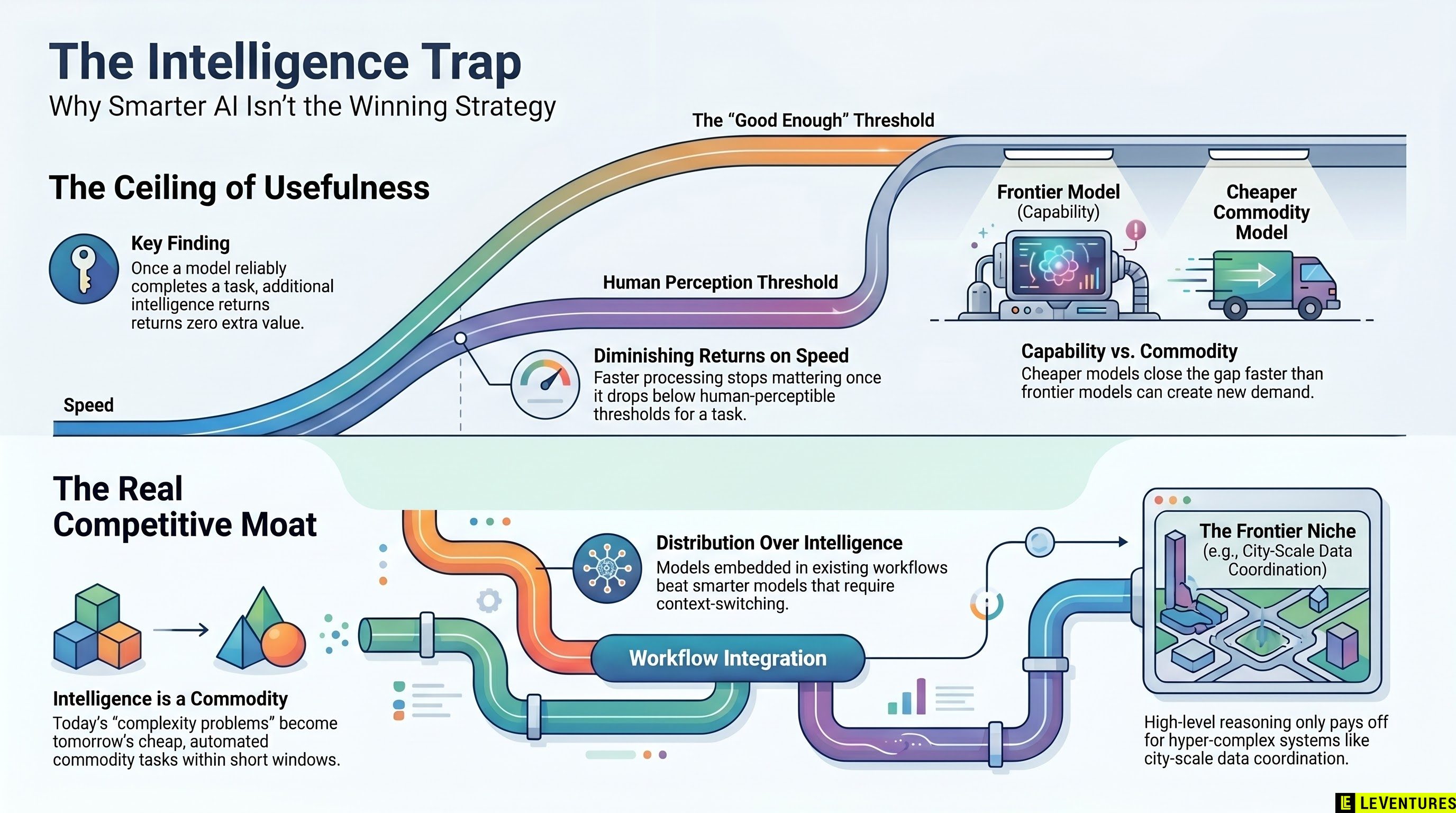
Start with the business model. If you want to use Claude on a subscription, you need their desktop app. Otherwise you’re paying API token fees, which scale painfully for heavy users. That’s not a moat - that’s a distribution wall. The intelligence itself, the actual model capability, is the only real differentiator. And that differentiator has a problem: it has a ceiling of usefulness for most tasks.
Every task has a ceiling
Every task category has a threshold. Once a model can reliably do what you need, more intelligence doesn’t return more value. Image generation hit this wall already. When a model can generate exactly what you visualized, additional inference gains you nothing. The same pattern will play out in coding. The models that are “just good enough” to write production-quality code will capture that market, and the frontier models won’t win on capability alone. They’ll just be overkill at a premium.
Inference speed follows the same curve. There’s a point where faster is meaningfully better - nobody wants to wait 30 seconds for a code completion. But once you’re below a human-perceptible threshold for a given task, the gains stop mattering. Speed has diminishing returns per industry and use case, just like intelligence does.
Good enough wins the market
The race to the top of the capability ladder is, paradoxically, a race toward irrelevance for most buyers. Large language model providers are competing intensely to serve a narrowing slice of use cases where frontier-level reasoning actually makes a difference. The average company doesn’t need that. They need reliable, fast, cheap, good enough. The cheaper models will close that gap faster than the frontier models can create new demand for their headroom.
Where frontier intelligence still pays off
Where frontier intelligence does have a defensible home is in tasks that genuinely scale with reasoning across many simultaneous dimensions - managing complex systems, synthesizing conflicting data streams at city or government scale, coordinating decisions across thousands of variables in real time. That’s where the extra inference pays off. But that’s not where most of the market is, and it’s not where most of the revenue will come from in the next few years.
The edge is distribution, not IQ
The real competitive edge in this market won’t be raw intelligence. It will be distribution, integration, and price. The model that’s embedded in your workflow and cheap enough to run constantly beats the smarter model you have to context-switch to use. Anthropic knows this, which is why they’re pushing the desktop app. But that’s exactly the kind of competitive advantage that gets competed away by whoever builds the better integration first.
What looks like a complexity problem today - “we need the smartest model for this” - will be a commodity task in a short window. That’s not pessimism about AI. It’s just how capability curves work.