Mythos and Fable are Not What You Think
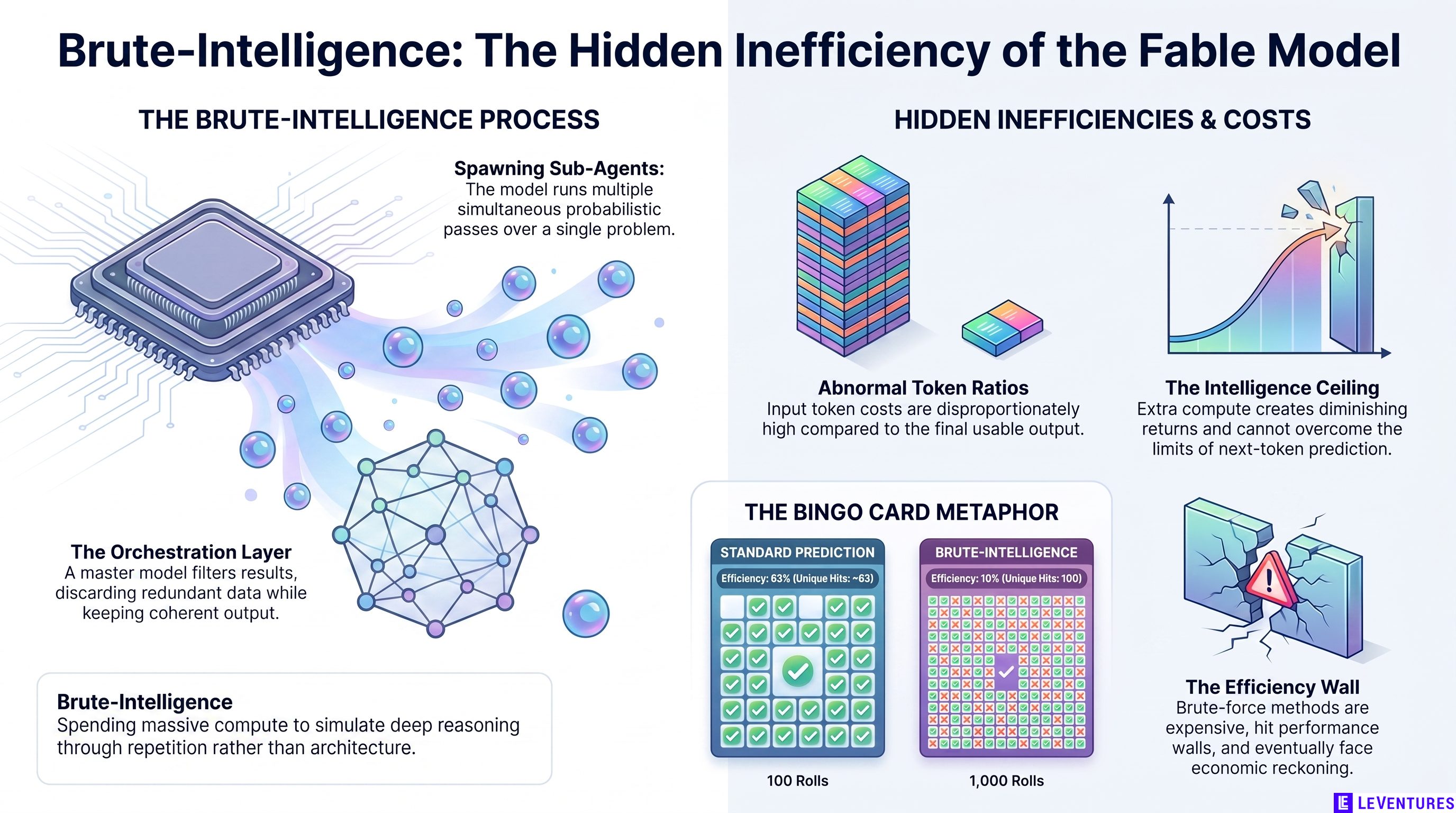
One or two prompts. That is all it took to burn through an entire week’s token budget on Fable.
Fable is Anthropic’s current flagship orchestrator, and like all large language models, you pay by the token. Tokens are the small chunks of text these models read and write. A week’s allocation should last a week. It did not come close. And it is not just one account. The forums are full of people reporting the same thing: one serious prompt, and the budget is gone.
What we do know: the input side runs extremely high compared to what you get back. Far more tokens going in than any normal task would require, and far more than previous models doing similar work.
Something is happening under the hood that Anthropic is not advertising.
What we already know about how these models think
Two ideas are worth connecting here. First, from this article, Smarter AI Is Not The Answer, there is a ceiling on how much intelligence any task actually needs. Past that ceiling, extra compute is just waste. Second, from When Inference Is Not Good Enough, next-token prediction only holds probabilities at the token level. At the level of whole sentences and paragraphs, those probabilities break down. This is also the root cause of hallucinations, where the model picks the right-sounding next token without a coherent concept behind it.
Put those two ideas together and the astronomical token ratio starts to look like a deliberate strategy, not a billing quirk.
Brute-intelligence
My read is this: Fable is not generating your answer once. It is spawning sub-agents, each of which runs its own probabilistic pass over the problem. The orchestrating model then reads all of those passes, keeps what is coherent, and discards what is redundant or wrong. You see a clean output. You pay for everything that went into producing it.
Think of a 100-sided die and a bingo card. You want to hit all 100 numbers. In 100 rolls, you will pretty much miss a bunch and repeat many others. So you roll 1000 times, collect every unique result, and throw out the duplicates. The card looks a little more complete. But you paid for 1000 rolls.
That is what I think “Fable-level intelligence” is. Not a smarter model. A busier one. A brute-force pass over the probability space, stitched together so it looks like a coherent, thorough answer. That is not wrong per se, but it is highly inefficient.
I am calling this brute-intelligence. The name is an oxymoron, which is the point. You are spending enormous compute to simulate the appearance of deep reasoning, not achieve it through better architecture. For anyone who has spent years writing software, this pattern is familiar. Brute-force is what you reach for when you cannot solve the problem elegantly. It works. It is also expensive and tends to hit a wall.
The deeper problem is that isolated agents cannot produce emergence. Emergence is what happens when parts of a system interact and build on each other, producing something more than any one part could do alone. But if each sub-agent runs in its own sealed context and an orchestrator just merges outputs at the end, no real interaction is happening. There is no mechanism for the pieces to compound. You are running parallel passes, not building toward something greater. That places a harder ceiling on what brute-intelligence can achieve, not a higher one.
Some will point to a well-known pattern in AI research: general methods plus more compute have consistently beaten approaches that tried to encode human knowledge by hand. That pattern is real. But it is different than agent orchestration. What that lesson actually showed is that machines learn better when you let them find structure on their own rather than having it imposed on them manually. The winning move was automation, not just more hardware. Brute-intelligence does the opposite. It layers a manual orchestration system on top of isolated agents and calls it intelligence. It does not inherit what made the compute-wins argument true.
A real algorithm is elegant because it describes an actual mechanism using math and logic. Orchestration is not that. It is a coordination layer, not a mechanism underneath.
That does not make it useless. There are real jobs where multi-agent systems get things done that a single pass would not. But useful is not the same as transformative. Orchestration at this level cannot fundamentally change what AI is capable of. It can cover more of the same ground. It cannot build new ground.
The experiment worth running is what happens if you go lower: agents that share a common structure for how they represent meaning, not just agents that share a task. If sub-agents could operate within the same representational space rather than passing text back and forth through an orchestrator, they might actually interact in ways that compound rather than just accumulate. That has not been done at scale. It might not work. But it is the direction that points toward something genuinely new, rather than more of the same.
What you are actually buying
There is a real argument for letting the orchestrator run. You set the task, walk away, and come back to something that is mostly built. For the right job, that is genuinely useful. You skip the tedious back-and-forth and a draft appears faster than you could manage turn by turn.
But mostly built is not done. What you come back to needs refinement. Usually more refactoring than you expect, because the orchestrator and sub-agents do not necessarily make the same architectural choices you would have made, though we recently and more often end up trading that for the convenience of AI. Whether Fable-style orchestration saves you net cost per goal is an open question. It may trade your steering time for your editing time at close to a one-to-one rate. The token bills we covered earlier tell part of that story.
The bigger problem is task routing. Fable appears to be billing you at Fable rates for every token in the chain. Not every subtask needs a frontier model. Summarizing a document, formatting output, validating a schema, pulling the right fields from a response: any of these could run on a much cheaper model at a fraction of the cost. An orchestration layer smart enough to handle complex reasoning should be smart enough to route simple jobs to smaller models. Either these systems do not do that, or they do and charge you a premium for the routing. Either way, you are paying Fable prices for work that a much lighter model could do just as well.
The walk-away convenience is real. The billing may not be calibrated to it.
The cost you are not seeing
The cost per output token is extremely high because what you pay for includes orchestration and all the discarded work: the dead-end sub-agent passes, the duplicate bingo numbers. Anthropic is charging a premium for a brute-intelligence approach and relying on that premium holding. Unless they’ve built some intra-agent structures or substrate, we will see how long that lasts before the economics force a change.
Meanwhile, the “intelligence” those extra tokens purchase still has a ceiling, the same one described earlier. A more expensive brute-force pass does not break through it. You are squeezing more juice out of the same lemon, at greater cost, with diminishing returns.
The orchestrators still need orchestrators. If you are relying on Fable to do all the thinking, you are paying for 1000 dice rolls and hoping it fills your card. The alternative is to stay in the loop: steer the model, shape the context, do your own due diligence. Human intelligence at the top, model abstraction and intelligence below that.
It’s turtles all the way down. But as one famous philosopher once said, I like turtles.