Your Shopify Products Are Now in ChatGPT. Here's What That Means.
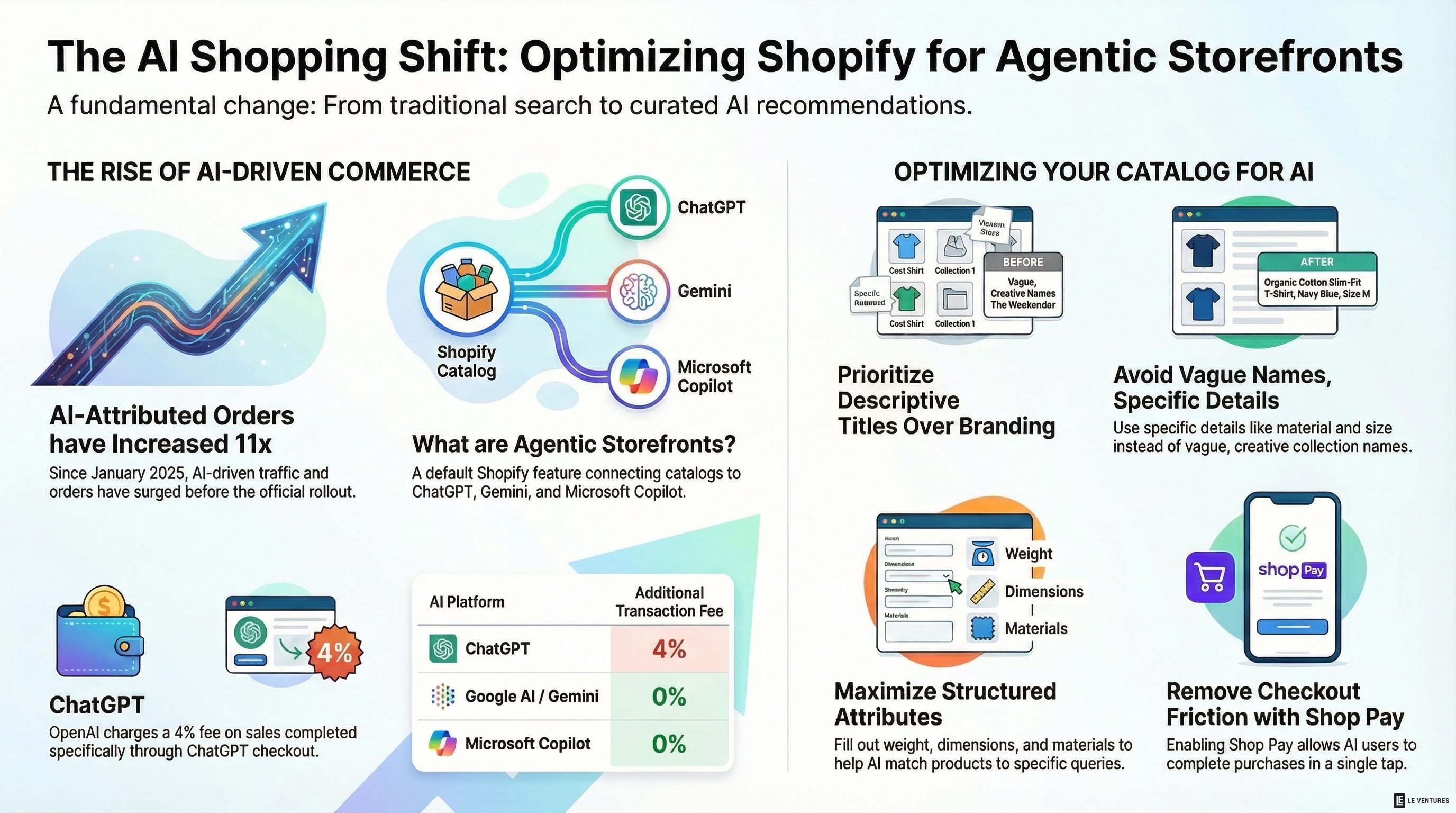
This week, Shopify flipped a switch.
Every Shopify store now has Agentic Storefronts turned on by default. That means when someone asks ChatGPT “What’s the best protein powder for smoothies?” or “I need a waterproof jacket under $200” - your products can show up in the answer. Not as an ad. As a recommendation.
And they can buy it right there.
This is the biggest shift in product discovery since Google Shopping. Here’s what you need to know.
What Actually Changed
Shopify built something called Agentic Storefronts. It connects your product catalog - through Shopify’s global catalog - to AI platforms like ChatGPT, Google AI Mode, Gemini, and Microsoft Copilot.
When a ChatGPT user asks a shopping question, the AI pulls from Shopify’s catalog, matches products to the query, and shows the most relevant results. The user can browse, compare, and buy - either in ChatGPT’s in-app browser on mobile or in a new tab on desktop.
You don’t need to install an app. You don’t need to opt in. It’s on by default for every Shopify store as of late March 2026. Your products are already eligible.
Why This Matters
The numbers are hard to ignore. AI-driven traffic to Shopify stores is up 7x since January 2025. AI-attributed orders are up 11x over the same period.
And that was before Agentic Storefronts rolled out to everyone.
Think about what this means for how people shop. Instead of searching Google, clicking through ten links, comparing reviews across tabs - they ask one question and get a curated answer with products they can buy immediately.
If your product shows up in that answer, you just skipped the entire funnel. No ad click. No landing page. No comparison shopping. Just a recommendation and a checkout.
If your product doesn’t show up, someone else’s does.
What Decides Whether Your Products Appear
ChatGPT doesn’t just randomly pick products. Shopify’s catalog system uses signals across millions of merchants to decide what to surface. Here’s what it looks at:
Product data quality. This is the big one. Your titles, descriptions, images, variants, and pricing need to be clear and accurate. Vague titles like “Summer Collection Item #4” won’t cut it. AI needs to understand exactly what you’re selling.
Structured attributes. Shopify’s catalog infers categories, extracts attributes, and consolidates variants so the AI sees clean, structured data. But it can only work with what you give it. If your product data is messy, the AI will skip you for someone with better data.
Inventory accuracy. Out-of-stock products showing up in ChatGPT recommendations is a bad experience for everyone. Keep your inventory synced in real time.
Store policies and trust signals. Shipping policies, return policies, reviews - these all factor into whether your store gets surfaced. A store with clear policies and good reviews is more likely to be recommended than one without.
How to Get Your Store Ready
Most stores have product data that was written for humans browsing a website. AI needs something slightly different. Here’s what to focus on:
Rewrite product titles to be descriptive. “The Classic” doesn’t tell AI anything. “Men’s Waterproof Hiking Boot - Leather, Vibram Sole, Wide Width Available” tells it everything.
Fill out every product attribute. Weight, dimensions, materials, size charts, color names. The more structured data Shopify can pull from your listings, the better your products match to specific queries.
Use high-quality images with clean backgrounds. ChatGPT shows product images in its responses. A lifestyle photo with ten items in frame doesn’t help someone decide whether to buy. Clean product shots do.
Write descriptions that answer questions. Not marketing copy. Think about what someone would ask about your product and answer it directly. “This bag fits a 15-inch laptop and has a waterproof zipper” is better than “Designed for the modern professional on the go.”
Turn on Shop Pay. Checkout friction kills conversions in AI shopping. Users expect fast transactions. Shop Pay lets returning Shopify customers check out in one tap.
The Fees
Here’s how the economics work:
- ChatGPT: OpenAI charges a 4% fee on sales completed through ChatGPT checkout, on top of Shopify’s standard processing fees.
- Google AI Mode and Gemini: No additional fees right now.
- Microsoft Copilot: No additional fees right now.
You keep the customer relationship and all their data. You’re still the merchant of record.
How to Track Performance
Orders from Agentic Storefronts show up in your Shopify admin with channel attribution. You can see exactly which orders came from ChatGPT vs. Google AI vs. Copilot.
Watch these numbers closely over the next few months. If AI-attributed orders start climbing, double down on product data quality. If they’re flat, your catalog probably needs work.
What This Means for Your Brand
This isn’t a future trend. It’s live right now, on every Shopify store. The question isn’t whether to participate - you’re already in. The question is whether your product data is good enough to actually surface.
The brands that clean up their catalogs now will capture the early wave of AI-driven shopping traffic. The ones that don’t will wonder why their competitors are getting orders from a channel they didn’t even know existed.
Want to know if your product catalog is ready for AI shopping? Start with a free audit. We’ll look at your product data, structured attributes, and store setup - and tell you exactly what to fix.