What Is GEO and Why Your Brand Needs It Now
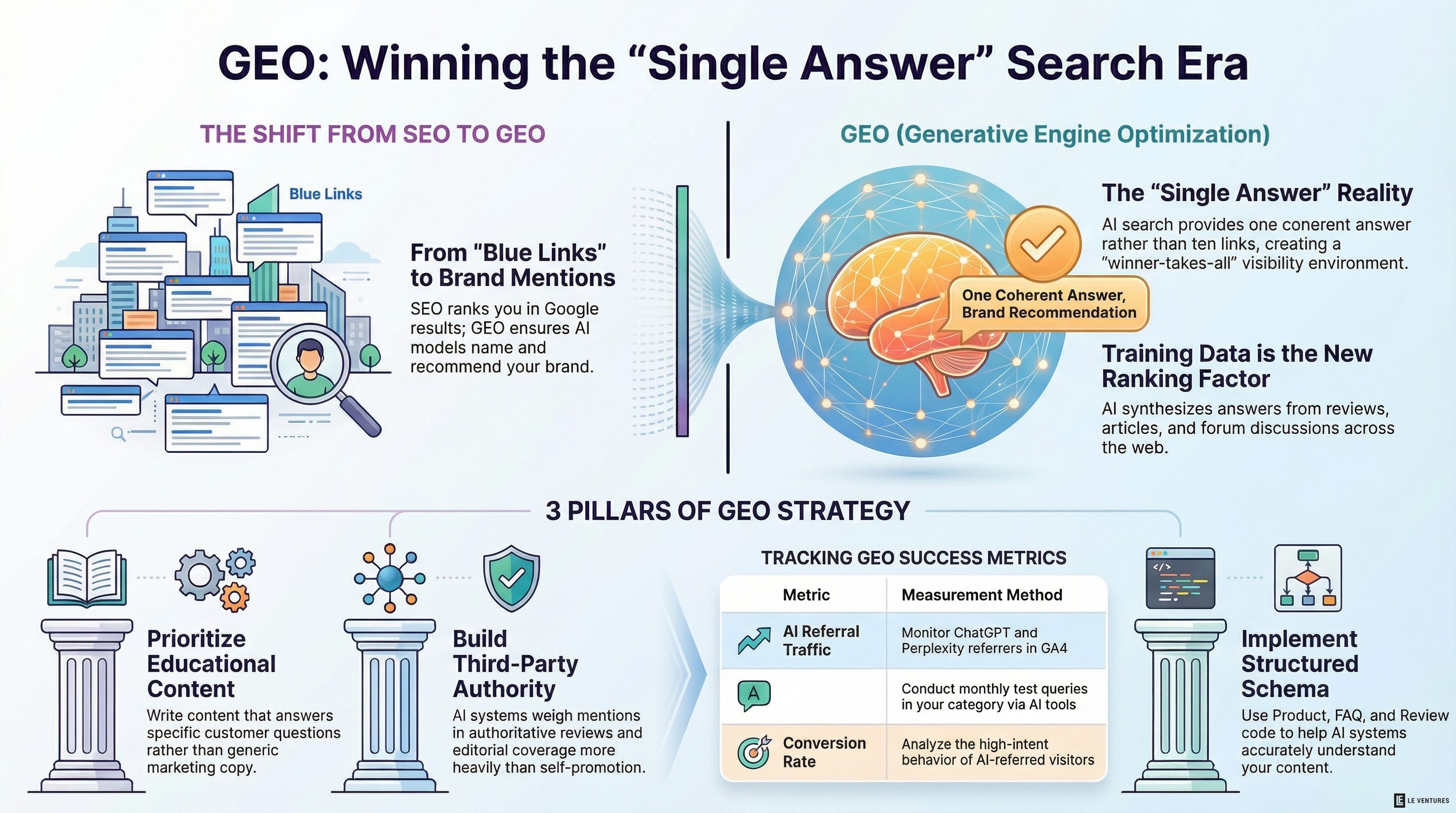
Search is changing fast.
A few years ago, if someone wanted to find the best running shoes, they typed it into Google and clicked through a list of links. Today, more and more of those same people are opening ChatGPT or Perplexity and asking: “What are the best running shoes for wide feet under $150?”
And they get one answer. Not ten links. One.
That answer might mention your brand - or it might not. If it doesn’t, you just lost a customer who never even knew you existed.
That’s what GEO is about.
What GEO Actually Means
GEO stands for Generative Engine Optimization. It’s what you do to make sure AI systems cite, recommend, and mention your brand when people ask questions in your category.
It’s different from SEO, but it builds on the same foundation. SEO gets you ranked in Google’s blue links. GEO gets you named in ChatGPT’s answer.
Both matter. Right now, most brands are doing some form of SEO and zero GEO. That’s a gap - and it’s one that closes fast once your competitors figure it out.
How AI Search Works
When someone asks ChatGPT a question, the model pulls from what it was trained on: articles, reviews, product pages, forum discussions, brand websites, news pieces. It synthesizes all of that into one coherent answer.
If your brand shows up frequently and authoritatively in that training data - in reviews, in blog posts that explain your category, in editorial coverage - you’re more likely to be named.
If you don’t show up in those places, you won’t be mentioned. It’s that direct.
Three Things That Help
1. Write content that answers real questions.
Not marketing copy. Actual answers to the questions your customers type into Google or ask AI. “What should I look for in a [your product category]?” is better than “Why [Your Brand] is the best choice.”
AI systems are trained on content that educates. Write more of that.
2. Get mentioned by other sites.
Reviews, editorial mentions, comparison articles, forums - these all feed into what AI systems know about your brand. If your brand only shows up on your own site, that’s a thin signal.
Coverage in third-party publications, especially ones that are authoritative in your category, adds weight.
3. Use structured data.
Schema markup - the code that tells search engines what your content is about - helps AI systems understand your pages more accurately. Product schema, FAQ schema, review schema. These matter.
What You Can Measure
One thing that makes GEO harder than SEO is that there’s no rankings report. You can’t log into a tool and see “you rank #1 for this query in ChatGPT.”
What you can measure:
- Traffic from AI referrers. ChatGPT, Perplexity, and others do send referral traffic. GA4 can capture this.
- Brand mentions in AI results. Run test queries in your category. See who gets named. Do this every month.
- Conversion rate of AI-referred visitors. This is often higher than other channels - people arriving from AI answers are usually further along in the buying process.
The Window Is Open
Right now, most ecommerce brands are not thinking about GEO. They’re still focused entirely on Google rankings, Meta ads, and email.
That’s fine - those channels still work. But the brands that start building AI search presence now will have a meaningful head start in 12 to 24 months when the rest of the market catches up.
The best time to start was a year ago. The second best time is now.
If you want to know where your brand stands in AI search today, start with a free audit. We’ll look at what AI systems know about you - and what they don’t.