The Customer Data Asset Most Stores Never Build
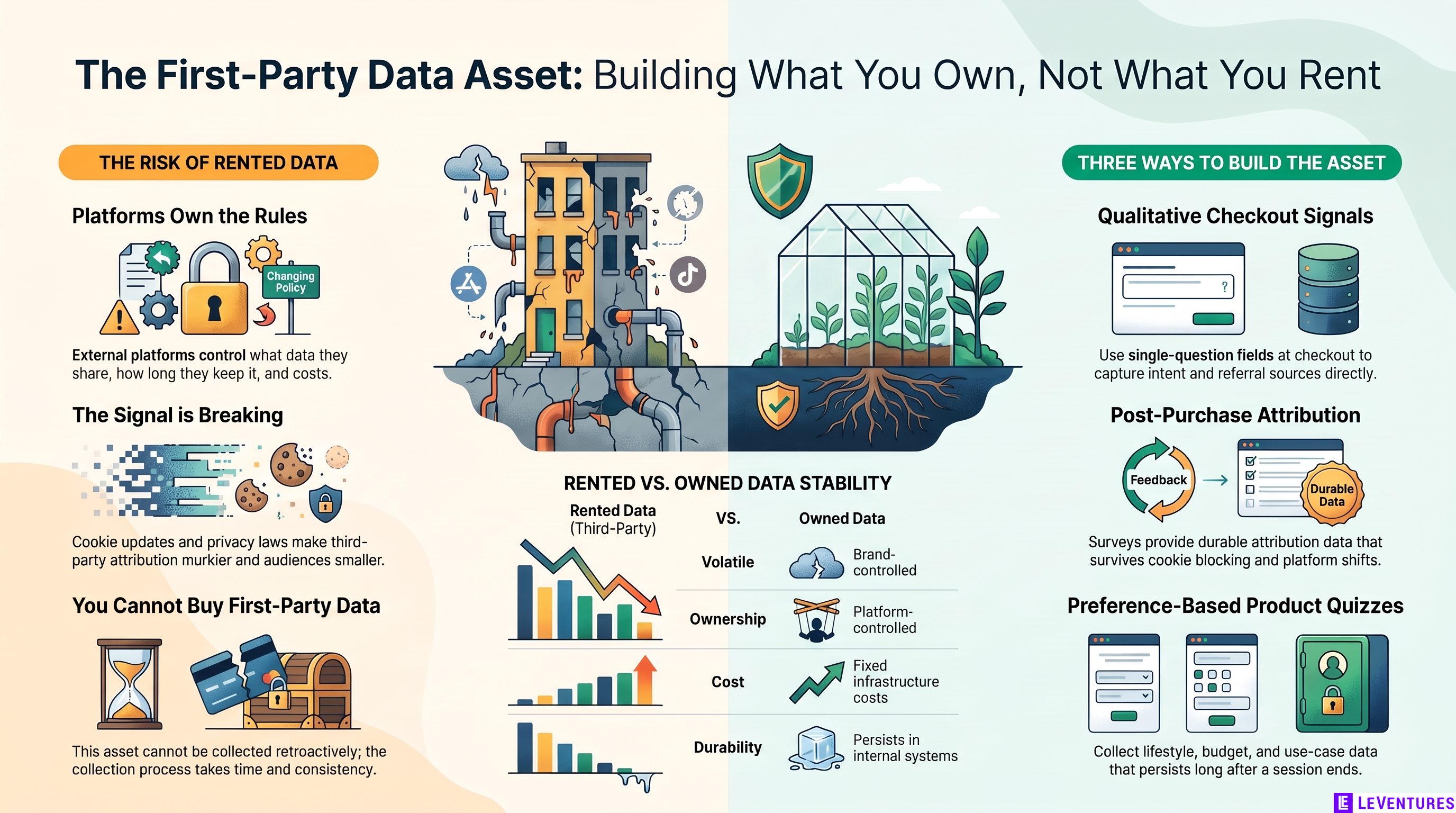
Most brands think their customer data is whatever lives in KlaviyoKlaviyoAn email and SMS marketing platform that e-commerce brands use to send campaigns and automate messages to customers. or GA4GA4Google Analytics 4, Google's current platform for tracking how people find and use a website.. It is not. Those platforms hold data about your customers. They do not give you ownership of it, and they can change what they share, how long they keep it, and what it costs you to use it whenever they want.
First-party data is different. It is information you collect directly, store yourself, and control completely. The distinction sounds minor until your Meta pixelMeta pixelA small piece of code placed on a website so Meta (the company behind Facebook and Instagram) can track visitor actions and measure whether ads led to purchases. attribution breaks, your Google Analytics reporting shifts after a consent update, or a platform reprices API access and suddenly your retargeting audiences cost twice as much to build. Then it matters enormously.
What Most Stores Actually Collect
Email address and order history. Sometimes a phone number if they pushed hard on SMS opt-ins.
That is it. And for a long time, it was enough. Platform cookies did the rest. They tracked behavior, built lookalikeslookalikesAd audiences that platforms build by finding new users who resemble a brand's existing customers based on shared traits and behaviors., matched purchases back to ad clicks. Brands got to run lean on data infrastructure and let the platforms do the heavy work.
That arrangement is breaking. Not all at once. Gradually, then suddenly, in individual markets and device types and browser updates. Attribution gets murkier. Retargeting audiences get smaller. CPMsCPMsShort for cost per thousand impressions, the price an advertiser pays for every 1,000 times an ad is shown. climb because the signal is weaker and more advertisers are fighting over it.
The brands that built their own data layer before this happened are in a different position now. Everyone else is discovering that you cannot buy first-party data. You can only collect it, and collection takes time.
The Compounding Logic
Think of first-party data the way you think of an email list, but richer. Every customer interaction is a chance to learn something: what they bought, how they answered a post-purchase survey, what they said they were shopping for, how long they have been buying from you, what they declined.
Each layer you add makes the whole more useful. An email address is a contact. An email address plus purchase history is a segment. Add self-reported preferences from a product quiz and you have personalization inputs. Add a stated “reason for buying” from a post-purchase survey and you have messaging context. Add a customer lifetime value score and you know who to spend real money to retain.
None of that requires a third-party pixelthird-party pixelA small tracking code added to a website by an outside company, used to collect data about visitor behavior and share it with that company's ad platform.. It lives in your systems, runs on your terms, and compounds with every new customer who comes through.
Three Places the Asset Gets Built
At checkout. This is where you already have consent and attention. A single well-placed question or an optional field can capture intent, referral source, or use case in the customer’s own words. This is qualitative signal most analytics tools miss entirely.
Post-purchase surveys. Short, simple, and underused. “How did you hear about us?” alone gives you attribution data that survives cookie blocking. Add “what were you trying to solve?” and you have copy research. The response rates on post-purchase surveys beat almost every other survey channel because the customer just bought something and they are engaged.
Product quizzes. The good ones do double duty. They guide a shopper toward the right product and they collect declared preference data in the process. Skin type, budget, use case, lifestyle signals. That data persists long after the session ends, unlike behavioral signals that evaporate when a cookie clears.
The Part You Cannot Recover Later
Here is the uncomfortable truth about first-party data: you cannot go back and collect it retroactively.
If you have been in business for five years and you start building this now, you have five years of customers you know only by their email and order count. You can enrich going forward. You cannot fill in what you never asked.
The brands that started collecting this data early have a structural advantage. Their audiences are richer, their personalization is more precise, and their ad targeting can run on signals they own rather than signals they rent. That gap widens every year and it is not one you can close by throwing money at a platform.
The tools to do this are not expensive. The survey tools, the quiz builders, the infrastructure to store and use what you collect, most of it is accessible to any store doing meaningful volume. The bottleneck is not budget. It is deciding that this is a real business asset worth building before a crisis makes the decision for you.