Fix Your Site Before You Spend More on Ads
Most brands hit a wall with paid ads and decide the solution is to spend more.
Sometimes that’s right. But often the problem isn’t the ads - it’s what happens after the click. Visitors land on your site, look around, and leave without buying. You spend more to bring more of those same visitors, and more of them leave without buying.
More traffic into a leaky funnel just costs more.
Before you increase your ad budget, look at what’s happening on your site.
Where the Money Leaks
There are four points in the funnel where most commerce brands lose sales.
The landing page.
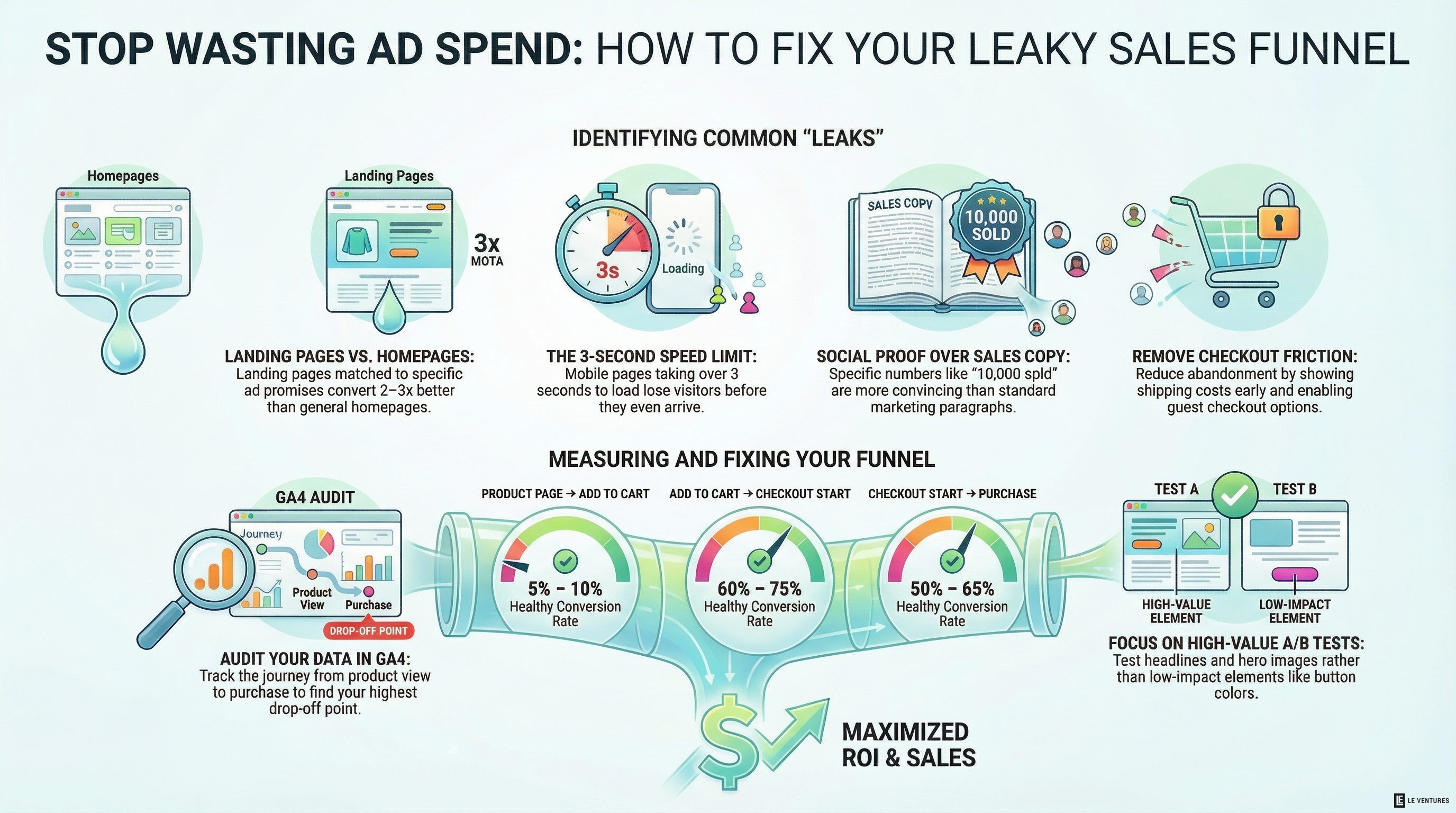
If you’re running paid traffic to your homepage, stop. Your homepage is for browsers. People who came from an ad had a specific reason to click - show them something specific. A landing page matched to the ad’s promise converts 2-3x better than a homepage.
Also: load time. If your page takes more than 3 seconds to load on mobile, you’re losing people before they even see your offer. Check your Core Web Vitals in Google Search Console.
The product page.
This is where most of the real decision-making happens. Common problems:
- Not enough product photos (people want to see the product from every angle)
- Reviews are buried or missing
- The price is visible but the value isn’t clear
- The “Add to Cart” button isn’t obvious on mobile
The single highest-leverage change on most product pages is adding more social proof - reviews, user photos, specific numbers. “Over 10,000 sold” is more convincing than a paragraph of copy.
The cart.
Cart abandonment rates average around 70%. That means 7 out of 10 people who add something to their cart don’t buy.
Some of that is normal - people use carts like wishlists. But a lot of it is friction: unexpected shipping costs, a checkout that requires account creation, too many fields to fill out.
The fastest fix: show shipping costs earlier (on the product page, not at checkout), and let people check out as guests.
The checkout.
Every additional step in checkout loses people. The best checkouts are one page, ask for the minimum information needed, and show trust signals (SSL badge, money-back guarantee, accepted payment methods) right next to the payment form.
Also: if you’re not offering multiple payment methods - at minimum Apple Pay, Google Pay, and PayPal alongside credit cards - you’re losing mobile buyers who don’t want to type their card number.
How to Find Your Biggest Leak
You don’t need to guess. The data tells you.
Set up a funnel report in GA4:
- Sessions that viewed a product page
- Sessions that added to cart
- Sessions that reached checkout
- Sessions that completed a purchase
Each step will show you a drop-off rate. Where do you lose the most people? That’s where you start.
A healthy funnel looks roughly like:
- Product page → Add to cart: 5-10%
- Add to cart → Checkout start: 60-75%
- Checkout start → Purchase: 50-65%
If any of those numbers are significantly lower, you have a specific problem to fix.
What A/B Testing Actually Means
A/B testing means showing two versions of a page to different visitors - half see Version A, half see Version B - and measuring which one gets more purchases.
It sounds simple, but most brands do it wrong:
- Testing too many things at once (change one thing at a time)
- Ending tests too early before you have statistical significance
- Testing things that don’t matter (button color rarely changes conversion rates)
The highest-value things to test:
- Headline on the product page
- Hero image (lifestyle vs product vs video)
- Shipping/guarantee messaging
- CTA button text (“Add to Cart” vs “Buy Now” vs “Get It Now”)
Run one test at a time. Let it run until you have at least 200 conversions per variant. Then decide.
The Math That Makes This Worth It
Here’s why CRO pays off faster than most ad spend increases:
Say you’re getting 10,000 visitors a month and converting at 2%. That’s 200 sales.
You have two options:
- Double your ad spend to get 20,000 visitors. Cost: significant.
- Improve your conversion rate from 2% to 3%. Cost: a few changes to your site.
Option 2 gets you to 300 sales with the same traffic. And that 50% lift in conversion rate now applies to every dollar of ad spend you run going forward.
Fixing your funnel doesn’t just save money now - it makes every future ad dollar more effective permanently.
If you want to know exactly where your site is losing sales, we’ll find it in the free audit. We look at your funnel numbers, your page speed, your checkout flow, and give you a ranked list of what to fix first.